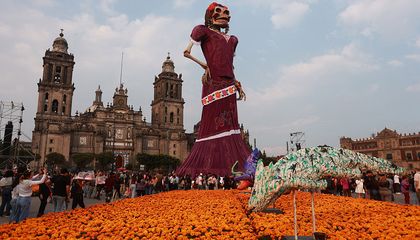
A massive female skeleton dressed in a long purple gown took center stage during Mexico City’s recent Día de los Muertos (Day of the Dead) celebrations—and set a new world record in the process. The towering figure known as La Catrina stood in the city’s main square, the Zócalo, as friends and families gathered to honor and remember their deceased loved ones during the annual holiday on November 1 and 2. Standing a little more than 109 feet tall—roughly the height of an 11-story building—the colorful installation broke the previous record of 92 feet set in Puerto Vallarta, Mexico, in 2023, according to Guiness World Records.
More than 140 people with the Xibalbá art workshop, led by director Carlos Camilo Báez, helped bring the project to life, using steel, fiberglass and papier-mâché to create La Catrina and her 88-foot-long dress. The statue is surrounded by a large memorial altar, or ofrenda, featuring an estimated 70,000 marigold plants grown in the city’s Xochimilco borough, Andrew Paul reports for Popular Science. The temporary installation was originally scheduled to stand through November 2.
However, Mexico City’s mayor, Clara Brugada, revealed on social media that the statue will remain on view through November 11. Una publicación compartida por Taller de Arte Xibalbá TAX (@taller_de_arte_xibalba) Observed primarily in Mexico and other parts of Latin America, Día de los Muertos is a festive, joyous occasion that celebrates the enduring connection between the living and the dead. Families create elaborate altars decorated with photographs, candles, marigolds, favorite foods and other meaningful items that are meant to help guide the spirits of their departed loved ones home.
They also clean their loved ones’ graves and decorate their headstones, gathering in cemeteries to remember and commemorate the people they have lost. The holiday, which was inscribed to UNESCO’s Intangible Cultural Heritage of Humanity list in 2008, blends Indigenous traditions with Catholic influences introduced by the Spanish conquest. Día de los Muertos draws on the beliefs of several ancient Mesoamerican civilizations, including the Aztecs, Toltecs, Olmecs and Maya.
These cultures viewed life and death as interconnected parts of a continuous cycle, rather than separate beginnings and endings. They believed the dead could periodically return to visit the living and reconnect with the earthly world. La Catrina has become synonymous with the holiday.
The figure was developed by José Guadalupe Posada, a Mexican cartoonist and graphic artist who lived from 1852 to 1913. La Catrina was just one of the many calaveras, or satirical skulls and skeletons, that Posada created during his lifetime. Originally known as Calavera Garbancera, La Catrina first appeared in 1912 on single-sheet broadsides that were sold to the poor and working classes throughout Mexico City for a penny.
Extract — continue reading at the source.