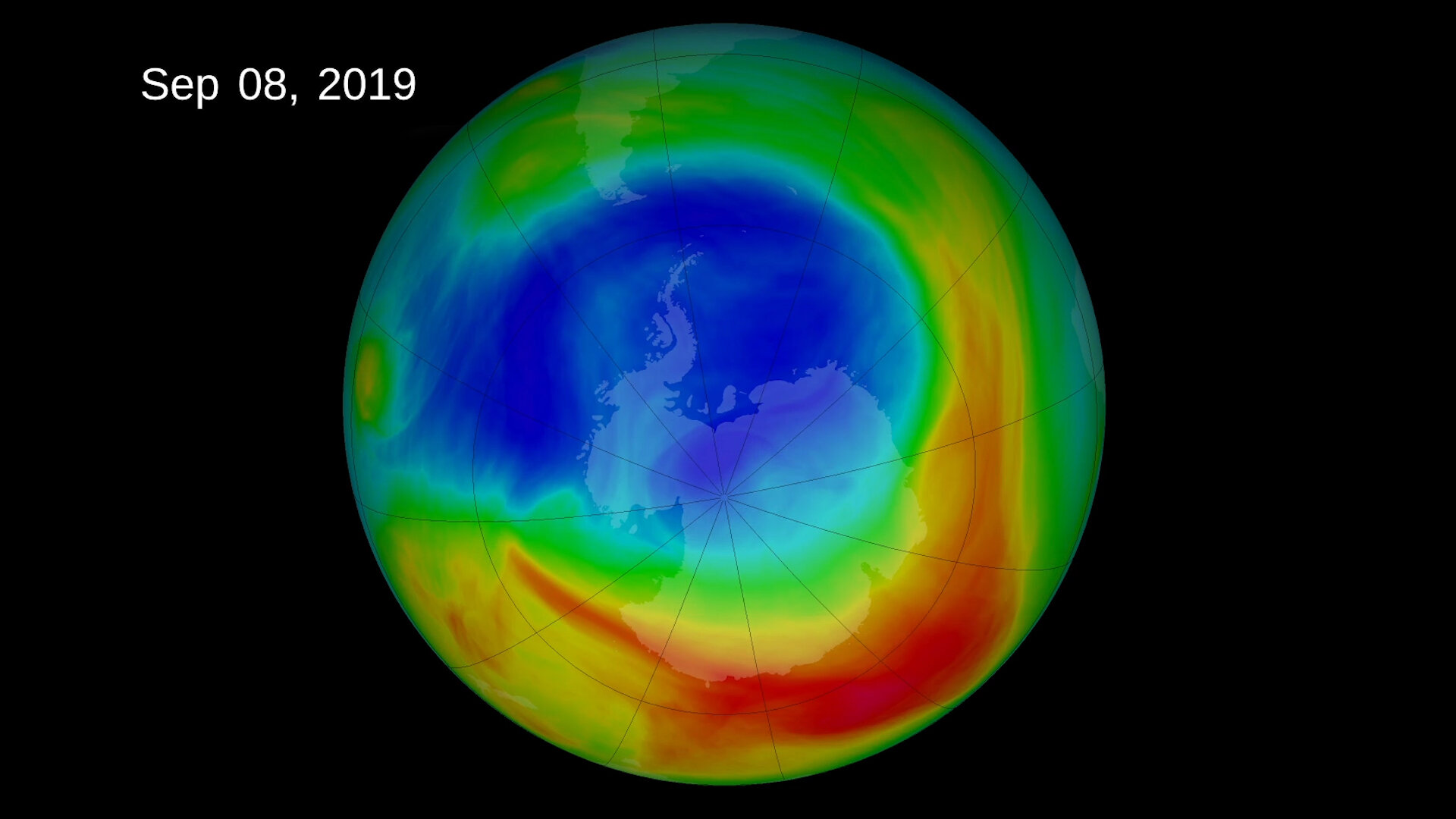
This article has been reviewed according to Science X's editorial process and policies. Editors have highlighted the following attributes while ensuring the content's credibility: The area covered by the Antarctic ozone hole peaked at more than 27 million square kilometers (10.4 million square miles) in September, the second-largest area ever observed for this time of year. We first predicted a severe ozone hole in May this year, when we observed changes in atmospheric circulation.
A very strong polar vortex and cold temperatures over the pole are driving the ozone hole's early and rapid growth. But rest assured, the Montreal Protocol—a landmark global treaty designed to protect the ozone layer by phasing out ozone-depleting substances—is still working. The levels of ozone-depleting substances in the stratosphere have dropped by about a third since their peak around 2000.
Despite its larger area, the 2026 ozone hole hasn't reached the depths of other large ozone holes in the past, meaning there is less "missing" ozone overall. This year's ozone hole started growing earlier than average in August, accompanied by low temperatures in the stratosphere. The hole then grew rapidly from the start of September.
Its area of 27.4 million square kilometers (10.6 million square miles) has been exceeded only twice: In 2000, the ozone hole briefly reached more than 28 million square kilometers (10.8 million square miles), and in 2015, it peaked in October at 27.9 million square kilometers (10.8 million square miles). The ozone hole forms in early spring inside the stratospheric polar vortex, a strong wind pattern that forms every winter and encircles Antarctica and the Southern Ocean. The very low temperatures inside the vortex lead to the formation of polar stratospheric clouds.
Chemical reactions on particles in this rare type of cloud then activate ozone-depleting gases. Once formed, the ozone hole's longevity depends on how well isolated the air is within the polar vortex. A cold, robust vortex leads to a long-lasting ozone hole.
Large-scale atmospheric dynamics therefore play a key role. Since the Montreal Protocol was signed in 1987, concentrations of ozone-depleting gases have declined. However, atmospheric dynamics can sometimes "prime" the polar vortex before spring.
Extract — continue reading at the source.