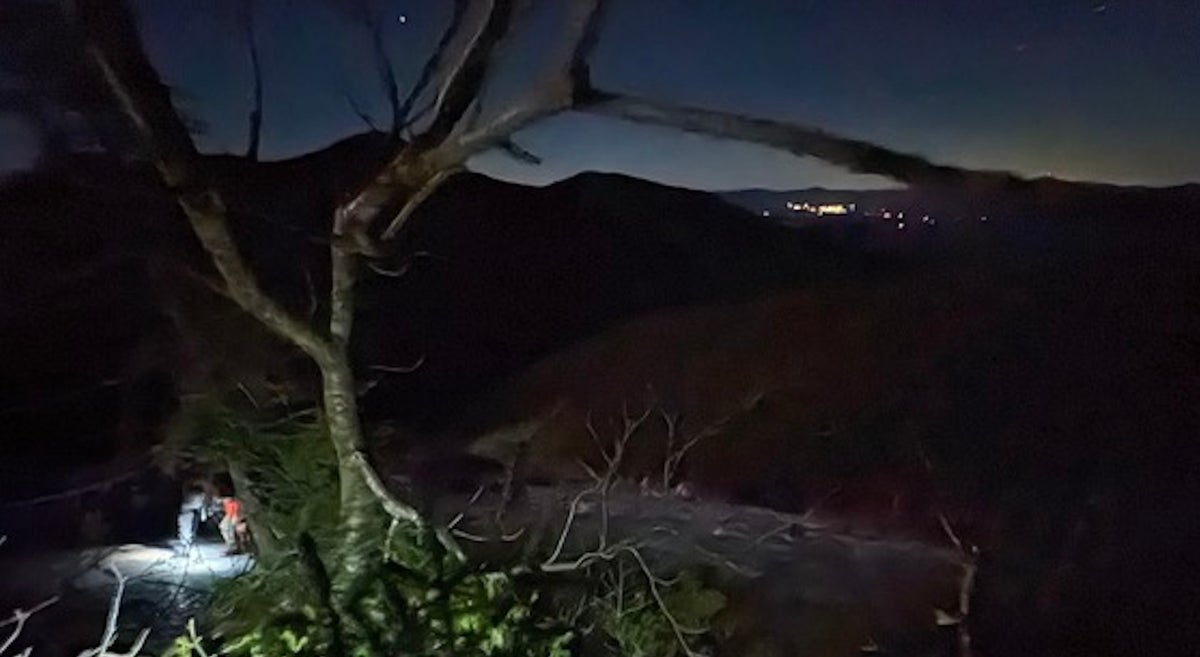
New York State forest rangers conduct an overnight rope rescue on Mount Colden in the Adirondack Mountains after climber Eric Le Bourhis became stranded on an icy rock slide near the Trap Dike on October 21, 2026. ( nvironmental Conservation) A 60-year-old Canadian climber was rescued from New York’s Adirondack Mountains on October 22 after spending seven hours standing on a frozen patch of rock and ice no bigger than a coffee table waiting for search and rescue. For the climber, named Eric Le Bourhis, that miserably stationary wait made him a model subject for rescuers. Le Bourhis was climbing Mount Colden, a 4,714-foot peak near Lake Placid, when he encountered ice and stopped to put on his crampons, the rescue report said.
But the bag containing them slipped away and slid down the mountainside, leaving him without the traction he needed to climb any higher. Worse, the wet rock he’d climbed earlier was now frozen, making it too slippery to descend. Le Bourhis was effectively trapped.
There was a cluster of trees just seven feet away offering a possible escape, but reaching them meant risking a potentially deadly jump across the icy slope. In a video interview released by the New York State Department of Environmental Conservation, Le Bourhis said he resisted the temptation to jump, a decision that spared him the risk of a potentially deadly fall. Should I activate the beacon?
Finally, when I saw the sun was setting, I decided to activate the beacon,” he said. And according to Chris Boyer, executive director of the National Association for Search and Rescue, it’s precisely those moments of desperation that can turn an already dangerous situation into something much worse. So we want to minimize their risk and maximize their survivability and findability,” he said.
Le Bourhis was climbing a route known as the Trap Dike, which winds through a steep, rocky passage on Mount Colden before opening onto broad, exposed slopes near the summit. He had climbed it before. Classified as a Class 4 climb, the route requires using both hands and feet, and a fall can be fatal.
After dropping his crampons, Le Bourhis activated his satellite distress beacon as the sun went down. Dispatch received the signal at 6:22 P.M., but Le Bourhis didn’t know whether help was coming. With no room to sit, he spent the next seven hours standing and trying to keep his increasingly tired legs steady.
Extract — continue reading at the source.