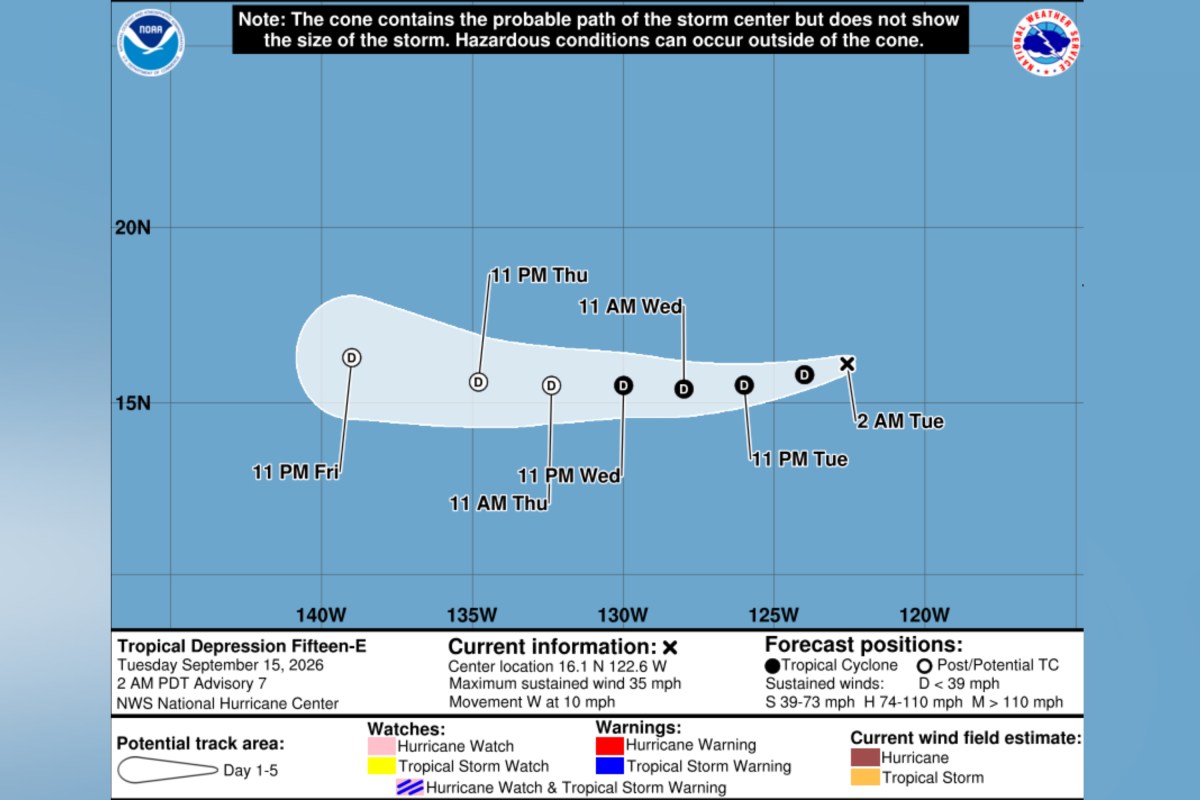
Tropical Depression Fifteen-E remains over the open Pacific, but its chances of becoming a tropical storm appear to be diminishing. The system’s formation comes during an eastern Pacific hurricane season influenced by El Niño, a recurring climate pattern that can alter tropical cyclone activity across both the Pacific and Atlantic basins. PDT Tuesday public advisory, the National Hurricane Center (NHC) said that Tropical Depression Fifteen-E was located around 950 miles west-southwest of the southern tip of Baja California.
The system was moving west at approximately 10 miles per hour—a motion expected to continue "for the next few days." The agency reported maximum sustained winds near 35 mph, with some higher gusts. "Little change in strength is forecast during the next couple of days," it added. According to the NHC’s update, there were no hazards affecting land and no coastal watches or warnings were in effect.
The agency’s previous update suggested the system could strengthen into a tropical storm, but the possibility was not mentioned in its latest advisory. "As of Tuesday morning, increasing amounts of dry air have continued to disrupt the organization of Tropical Depression 15-E," AccuWeather meteorologist Nick Arman told Newsweek. "While there initially seemed like a window for this to become a tropical storm, this dry air, combined with increasing wind shear will likely prevent any intensification of TD 15-E, keeping it as a tropical depression over the next few days before it eventually loses organization and dissipates later this week, well southeast of Hawaii," Arman said.
The meteorologist added that, while the system may still have an opportunity to become a short-lived tropical storm, "this seems increasingly unlikely at this point." "We do not believe [the tropical depression] poses any threat for direct impacts to land, including the United States, as the aforementioned dry air and wind shear will cause it to dissipate well before reaching the Hawaiian Islands," said Arman. According to the NHC, a tropical depression is a tropical cyclone with maximum sustained winds of 38 mph or less. If its winds strengthen to 39 to 73 mph, it becomes a tropical storm and receives a name.
A system is classified as a hurricane once its maximum sustained winds reach 74 mph or higher. Forecasters previously said the Pacific could see more activity than average this year, thanks in part to the effects of El Niño conditions are currently strengthening, reinforcing their influence on tropical cyclone activity across the Pacific. That broader influence can help shape the environment in which individual systems develop, including Tropical Depression Fifteen-E's prospects for strengthening or weakening.
"El Niño conditions are associated with fewer tropical storms and hurricanes, especially in the Western Atlantic Ocean Basin," Matthew Rosencrans, NOAA’s lead for its seasonal hurricane outlook, told Newsweek previously. "El Niño conditions are associated with more tropical storm and hurricane activity during the eastern and central Pacific hurricane seasons." Forecasters are also monitoring another region of the Pacific for additional development. The NHC said an area of low pressure could form well south of southwestern Mexico by the end of this week or early next week.
Extract — continue reading at the source.