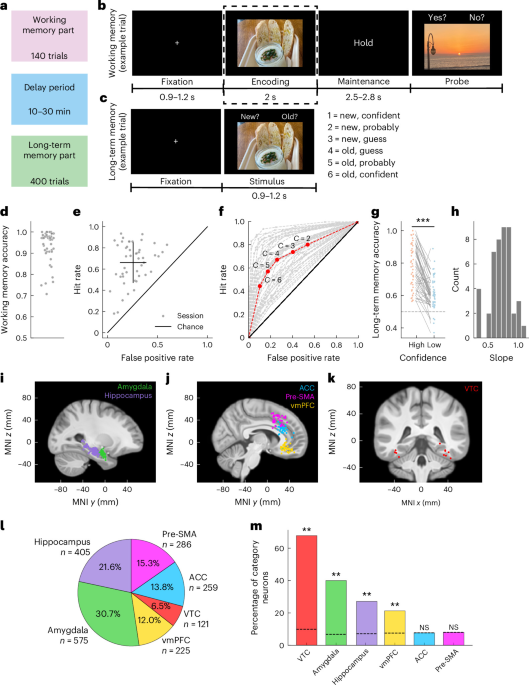
Controlling whether an experience is encoded into long-term memory and thus later remembered is a crucial aspect of memory. Here we examined single-neuron activity in the human brain while participants formed memories for novel visual stimuli and later retrieved them with confidence ratings. Category-selective amygdala neurons exhibited elevated firing during encoding of later remembered items relative to later forgotten items.
This effect was predictive of the episodic aspect of the memory, was restricted to the preferred category of each cell, emerged earlier and was stronger in the amygdala compared to the hippocampus, and did not depend on stimulus valence and arousal. Successful memory formation was accompanied by enhanced spike-field coherence between the activity of amygdala category cells and hippocampal field potentials. These findings demonstrate that stimulus-specific recruitment of the amygdala predicts memory formation and suggest category cells in the right amygdala as a target for interventions to treat disorders affecting episodic memory in humans.
In a typical day, we experience a large number of events, each accompanied by large amounts of sensory information. Imagine walking through a farmers’ market: the sounds of people talking, the faces in the crowd, the scent of freshly cooked food from nearby stalls and the taste of an exceptionally delicious dish all stimulate your senses. Despite this rich sensory experience, typically only a small and select subset of this experience is transformed into long-lasting episodic memories.
The neural mechanisms that determine whether a long-term memory of an experience is created, and if so what aspects of the experience are encoded, are only beginning to be understood1,2,3. A key motivation for identifying mechanisms that control memory encoding processes is that modulating such mechanisms could be a way to treat memory disorders. A main hypothesis is that emotionally salient experiences are selectively tagged for long-term memory consolidation through modulation of hippocampal synaptic plasticity by the amygdala4,5.
While classically thought to be restricted to highly emotional events, studies have shown that amygdala stimulation enhances memory for a wide range of neutral stimuli without inducing emotional responses6,7,8. This is in contrast to hippocampal stimulation, which in many circumstances disrupts rather than enhances memory formation9,10,11,12. While the amygdala is a potential target for a memory prosthesis, the lack of an underlying mechanism leaves it unclear what exactly the therapeutic target is in the amygdala for enhancing memory.
In particular, it remains unclear whether the amygdala is involved in processing the content of the to-be-encoded memory itself or whether its role is to modulate attention or arousal. Here we use large-scale single-neuron recordings in the human brain to examine this important open question. We compare the response of cells in the human amygdala to novel stimuli between those that were later remembered and those that were later forgotten (difference due to memory approach13,14,15).
Extract — continue reading at the source.


