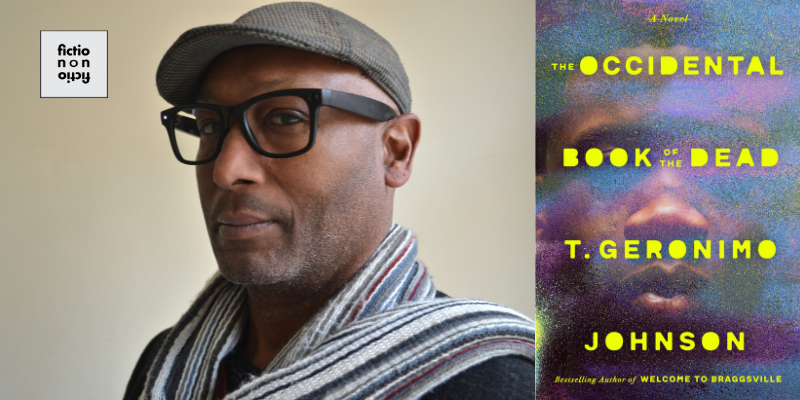
Ganeshananthan and Whitney Terrell to talk about his new novel, The Occidental Book of the Dead. He discusses how the book addresses white supremacy and the United States’ deep-seated and racist mythology through the perspective of George Washington Jonson, a black police officer working in a fictional version of Atlanta. Johnson talks about researching police work but almost entirely avoiding depicting scenes of it on the page, and also explains why the book transitions from third to first person.
He reflects on how structures of The Egyptian Book of the Dead and other classics are incorporated into the story. He reads from The Occidental Book of the Dead. To hear the full episode, subscribe through iTunes, Google Play, Stitcher, Spotify, or your favorite podcast app (include the forward slashes when searching).
You can also listen by streaming from the player below. Check out video versions of our interviews on the Fiction/Non/Fiction Instagram account, the Fiction/Non/Fiction YouTube Channel, and our show website: https://www.fnfpodcast.net/ This podcast is produced by V.V. Ganeshananthan, Whitney Terrell, Archer Walsh, Elizabeth Willis, and Eric Thong.
The Occidental Book of the Dead • Hold It ‘Til It Hurts • Welcome to Braggsville A Man in Full by Tom Wolfe • The Handmaid’s Tale by Margaret Atwood • Autobiography of an Ex-Colored Man by James Weldon Johnson • The Egyptian Book of the Dead, translated by E.A. Wallis Budge • The Consolation of Philosophy by Boethius • Confessions by St. Augustine EXCERPT FROM A CONVERSATION WITH T.
Ganeshananthan: This novel is broken up into different parts, and the first part is written in the third person, and then there’s this shift to [George Washington] Jonson’s first-person voice, which is prefaced with, among other things, a note about how it should not be read aloud. But there’s all of this text appended to the story that gives it the appearance of a certain other kind of story. For example, there’s episode credits or a fake copyright page, and then this perspective rupture.
And I want to ask how you developed this structure and if you always knew that this was where you were headed. Geronimo Johnson: No, I didn’t always know I was headed in this direction. At one point the book was, I think, a thousand pages.
Extract — continue reading at the source.

/https://tf-cmsv2-smithsonianmag-media.s3.amazonaws.com/filer_public/7b/84/7b840680-9e03-472b-b6a8-1f13793fdeef/5454.jpeg)
/https://tf-cmsv2-smithsonianmag-media.s3.amazonaws.com/filer_public/a7/fb/a7fbdd05-7c55-4060-8e76-177d18ede3c5/260821mc_130.jpg)