/https://tf-cmsv2-smithsonianmag-media.s3.amazonaws.com/filer_public/99/82/99828cb4-f7ff-4b53-a540-5341c92c851d/was-there-really-a-fem.jpeg)
More than five millennia ago, a queen named Meretneith ruled ancient Egypt. That’s according to a study recently published in Prague Egyptological Studies, for which researchers used digital tools to re-examine an old photograph of hieroglyphic inscription lost to time. They say the symbols suggest that Meretneith (also spelled Merneith or Meret-Neith) was not just an interim ruler or regent but possibly equal to an Egyptian king.
Our new research … might do just that.” Meretneith lived during ancient Egypt’s first dynasty. She was likely related to its third pharaoh, King Djer, who ruled Egypt in the 2800s B.C.E. Historians have long known that Meretneith was an important royal: Her vast burial complex in Abydos’ royal cemetery contained the graves of 41 servants and courtiers as well as sealed jars full of wine.
And an ancient list of rulers found in the tomb of King Den in Saqqara, another first dynasty pharaoh, identified Meretneith as “king’s mother.” From this, historians guessed she might have acted as regent during Den’s childhood. Only one known text might provide evidence of Meretneith’s sovereignty. It’s a hieroglyphic inscription written on an ancient stopper, a plug used to seal a jar.
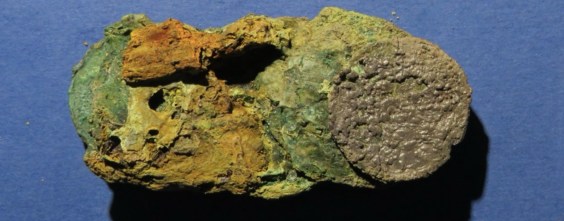
The English archaeologist Walter B. Emery found 13 of these mud stoppers in the 1940s, at the entrance to a tomb in Saqqara. Each stopper was inscribed with four special glyphs called serekhs, which represent Egyptian rulers.
Emery said that the first and last serekhs represented Djer and that the middle two represented Meretneith—a controversial claim. The whereabouts of all 13 stoppers and the original glass plate of Emery’s black-and-white photograph are “unknown,” Kelly tells Live Science’s Owen Jarus. So she and study co-author Crystal Miller, a bioarchaeology researcher at the University of Bucharest, in Romania, worked with what they had: a digital scan of the archival photo.
The researchers isolated the hieroglyphs, inverted the colors and converted the image to a scalable vector. Kelly writes in the Conversation, “We produced a crisp digital replica—much like a high-tech pencil rubbing over a coin.” Per the study, the symbols in the second and third serekhs are consistent with Meretneith’s patron deity and name. The characters identify Meretneith using the “primary mark of rulers in this period,” Kelly writes, which means “she really was a female king … a true equivalent to a male ruler.” Kelly tells Live Science that Meretneith likely co-ruled with Djer, who might have been her father, and later acted as regent for her son Den.
Extract — continue reading at the source.
/https://tf-cmsv2-smithsonianmag-media.s3.amazonaws.com/filer_public/2c/1c/2c1cb4b9-d775-4091-b0ab-15c69ec5e325/natalie_veekmans_this_is_my_best_side.jpg)