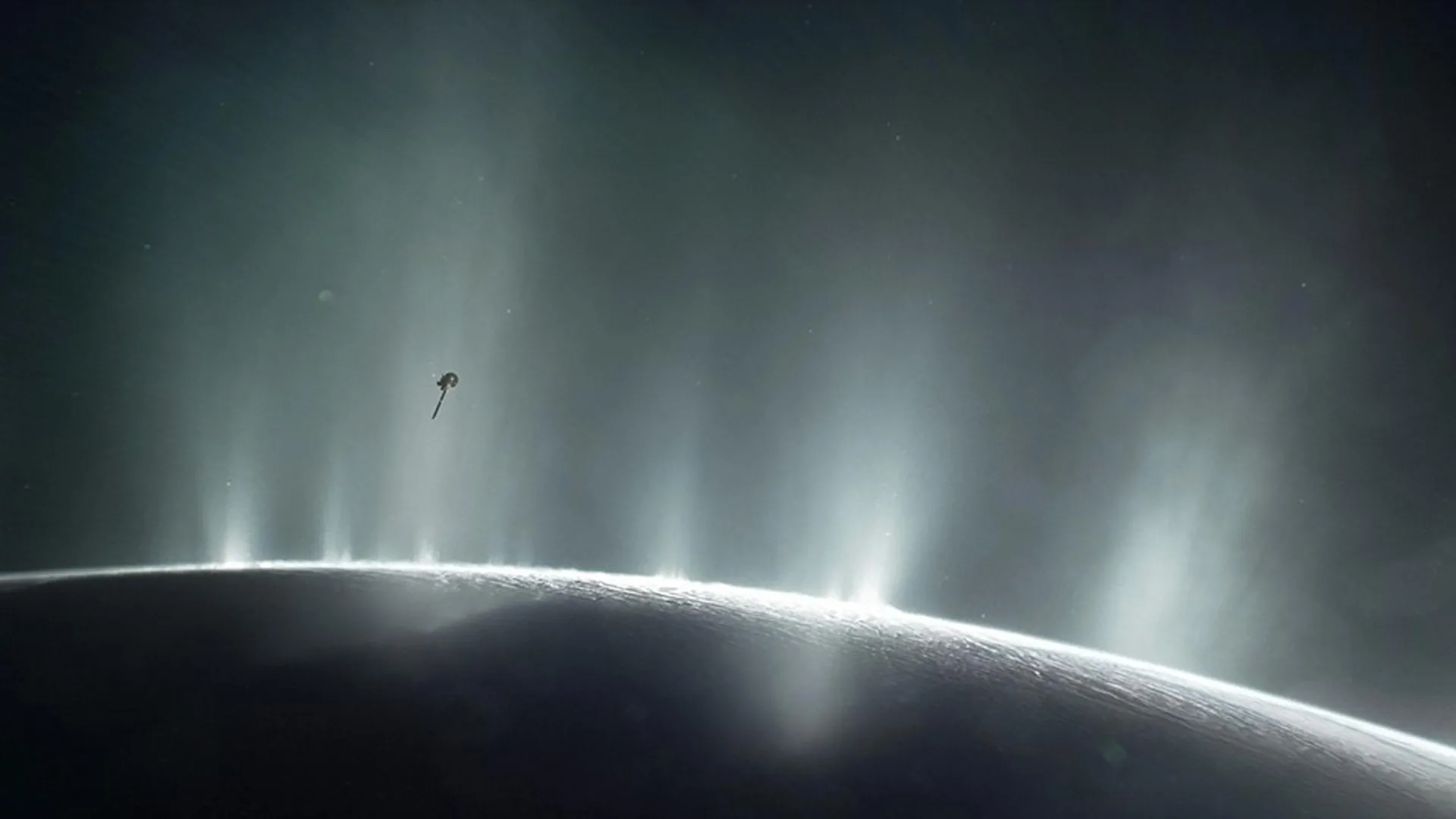
Saturn's moon Enceladus is covered in ice, but beneath that frozen shell lies a global ocean. Near the moon's south pole, fractures in the crust release water vapor and ice particles into space. Those particles give scientists an unusual way to study an alien ocean without having to drill through kilometers of ice.
An international team that includes researchers from the Earth-Life Science Institute (ELSI) at the Institute of Science Tokyo has now investigated what happens to that ocean water as it moves from beneath the surface and eventually becomes the tiny ice grains detected in space. Cassini Found Surprisingly Diverse Ice Grains Between 2004 and 2017, the Cosmic Dust Analyzer on NASA's Cassini spacecraft measured the composition of individual ice particles in Saturn's E-ring. That ring is continually supplied with material erupting from Enceladus.
A team led by Prof Frank Postberg at Freie Universität Berlin examined 961 mass spectra from salt-rich grains known as Type 3 particles. If the grains were simply small samples of the same ocean water, scientists might expect them to contain broadly similar mixtures of salts. Instead, the grains varied dramatically.
Some were especially rich in sodium chloride, while others contained higher amounts of carbonates, phosphates or potassium chloride. One particularly striking pattern was that chloride and carbonate rarely appeared together in the same sodium-rich particle. That raised a basic puzzle.
If all of these grains came from the same ocean, why did their chemical compositions differ so much? Recreating Enceladus' Ocean Droplets in the Lab To explore that question, Professor Yasuhito Sekine and colleagues at ELSI created laboratory droplets containing the major salts thought to be present in Enceladus' ocean. The researchers froze droplets of different sizes under different cooling conditions, then studied how the chemical elements were distributed once the droplets had solidified.
The results showed that the speed of freezing plays a major role. In droplets about 200 micrometres across, salts became separated into different regions when freezing occurred relatively slowly, at approximately 10 K per minute or less. When the droplets froze more quickly, their chemical ingredients remained much more evenly mixed.
Extract — continue reading at the source.