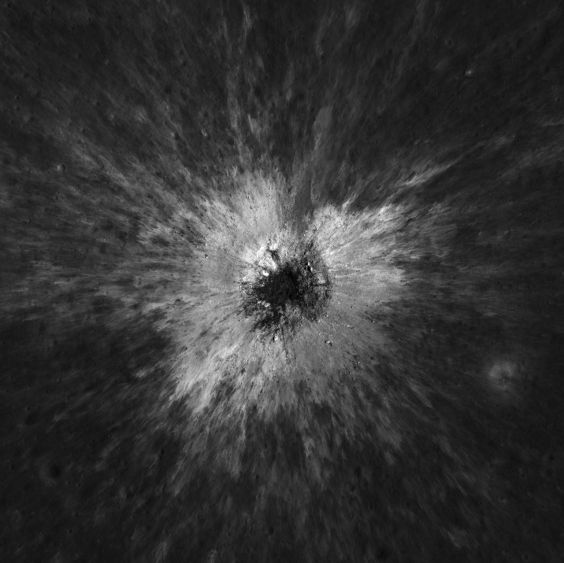
If you’ve ever come back from spring break with an ill-advised tattoo, congratulations—now you know how the moon feels. During the spring of ‘24 our satellite got pelted with an object as big as a six-story building, and it’s sporting a brand new crater as a result. The Lunar Reconnaissance Orbiter (LRO), which has been orbiting the moon for 17 years, regularly surveys the lunar surface with its wide-angle camera, capturing vast swaths of the terrain that are then flagged by software for further review.
Most of them turn out to be false positives or otherwise unremarkable, but this time was different. NASA image-processing specialist Robert Wagner was the first to notice the moon’s new dimple in 2025. Read more: “Here’s the Crater SpaceX’s Rocket Left on the Moon” “I just stopped, dropped everything, and started looking into what that spot was,” Wagner said in a statement.
The spot turned out to be 728 feet wide (roughly the size of two football fields), and 141 feet deep. The moon is regularly showered with microasteroids and more, but a lunar impact this large is extraordinarily unique, occurring only once in a century. The NASA team then switched to the LRO’s thermal camera (the Diviner), and discovered something interesting.
The four-mile area surrounding the crater was around 16 degrees Fahrenheit cooler than the lunar surface. According to a second Science Advances paper on the impact, that’s pretty common for craters larger than 20 meters (around 66 feet). When an object hits the moon’s surface it “decompacts” the dusty regolith, and the fluffier moon dirt doesn’t retain heat as well.
This churning process is known as “impact gardening,” and it happens more frequently than you might think. It was long thought that the moon had a more static surface, with the top half inch or so of soil only overturning once every 10 million years. But according to a study from a decade ago, it actually happens once every 80,000 years.
Even on the moon, time heals all wounds—no such luck with spring break tattoos, though. Subscribe to our free newsletter. Lead Image: NASA Goddard/Intuitive Machines/Robert Wagner
Extract — continue reading at the source.


/https://tf-cmsv2-smithsonianmag-media.s3.amazonaws.com/filer_public/07/f2/07f2373b-918c-4e19-8b22-9a2d4398bc64/mcgetchinobligueviewlrocnac.jpeg)
/https://tf-cmsv2-smithsonianmag-media.s3.amazonaws.com/filer_public/ee/af/eeaf8702-0ac4-473b-9399-aefed4f4c3ae/2026-08-26_return_of_the_buffalo_rush-10.jpg)
/https://tf-cmsv2-smithsonianmag-media.s3.amazonaws.com/filer_public/d4/68/d4685b8a-3c7c-4949-be40-9a603106b3b3/gettyimages-2285809343.jpg)