It was the world’s first experience of antisemitism “gone viral”, said Barbara Warnock, a co-director of the oldest Holocaust archive, the Wiener Holocaust Library in London. It was 1894 and printing presses were faster than ever before. France’s prohibitive censorship laws had been lifted, and then along came the Dreyfus affair: a public shouting match that followed the wrongful conviction for treason of Alfred Dreyfus, a 36-year-old French army captain.
The clash between those insistent on Dreyfus’s guilt, as a Jewish man deemed to have a questionable allegiance to the French republic, and his outraged defenders triggered a deluge of newspaper specials, bespoke journals, posters and other polemics. A florid sample of the outpouring – including a British newspaper’s special edition, heavily coloured by an anti-French agenda – will go on display this week in a new exhibition at the Wiener Holocaust Library, 120 years after Dreyfus’s exoneration, promotion and award of the Légion d’honneur. He fled Germany for the Netherlands in 1933 after the rise of the Nazis, and then escaped from Amsterdam to London in 1938, bringing with him an extensive collection of documents chronicling the rise of antisemitism.
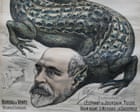
Among the 40 or so Dreyfus exhibits on display are pieces that Wiener sourced, but there are others collected in the intervening decades by the library and a haul that is on long-term loan from Birkbeck, University of London. The intention is to bring to life the toxic debate that split France the 1890s and early 1900s as Dreyfus languished in solitary confinement on the notorious Devil’s Island penal colony off French Guiana. Among the most eye-catching of the exhibits is a large poster in which Arthur Ranc, a leftwing politician, writer and newspaper editor who supported Dreyfus, is caricatured as an alligator-like creature with razor-sharp teeth.
It was one among a series of such posters titled the Musée des Horreurs, said Clara Dijkstra, one of the curators of the exhibition. They are reflective of a relaxation of the press, but actually after a year of them being published the government finally decided they were too grotesque and shut down publication of them.” A copy of the rightwing newspaper La Libre Parole, founded by Édouard Drumont, initiator of the Antisemitic League of France, is notable for its “grotesque antisemitic imagery on its cover”, said Dijkstra. I think that really captured people’s attention.” One journal published in France specifically to cover the Dreyfus affair emerged in direct response to an open letter, titled J’Accuse, written by the novelist Émile Zola to the French president, Félix Faure, in 1898.
He accused the French government of antisemitism and a cover-up. Zola was later convicted of libel and fled to England. One image in the publication, titled Psst….!, shows a Prussian officer pulling the strings of a mask of Zola’s face, and behind it is a caricature of a Jewish man.
Press, Polemic and the Dreyfus Affair, runs from 5 November to 19 March at the Wiener Holocaust Library.
Extract — continue reading at the source.