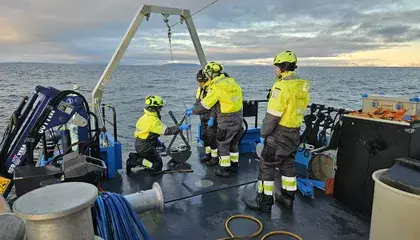
The sun never sets during the Arctic summer; it only flirts with the horizon to create an eerie twilight. From the deck of a research vessel on the seemingly endless expanse of gray, cold ocean, this offers the only natural sense for the passage of days. Juan Galarza, a molecular ecologist at the University of Oulu in Finland, often lost track of time due to these “disorienting” conditions, as he and his team combed the high Arctic during the summer of 2024.
They spent the perpetual daylight obsessively staring at a deep-sea scanner’s monitor and hoping for signs of methane bubbles. Such a signal could indicate that they had found a cold seep, a deep-sea site from which fluids or gases, like methane, escape through cracks on the seafloor. Through an energy-producing process known as chemosynthesis, microscopic life can sustain itself on these gases, thriving in the total darkness and near-freezing conditions.
And some of these bacteria, Galarza believes, could kickstart clean energy innovation. Cold seeps vs. hydrothermal vents A fellow marine biologist had alerted Galarza about simple bacteria thought to feed off methane at cold seeps in the Arctic and naturally produce hydrogen as a byproduct of their metabolic cycle. This potential inspired him to dream: If only he could find these microbes in the sediment and study how they produce hydrogen, it could lead to new ways of making hydrogen fuel, a potentially clean and renewable energy source that produces only water as a byproduct when burned.
His team has returned to the Arctic seafloor two times since to find and collect bacteria samples, most recently this summer. Galarza says he’s encouraged by their progress toward harnessing the microbes’ hydrogen-producing genes in sustainable fuel development. But the Arctic Ocean is undergoing rapid alterations due to climate change.
As they search the seafloor for new discoveries, scientists are acutely aware that the life there might change—or even disappear—before it is fully understood. Natural hydrogen, as this is known, is rare; to produce it, the element usually needs to be separated from hydrogen-containing molecules, such as water or natural gas. While hydrogen has the potential to be a clean alternative fuel for combustion engines, the need to isolate the element has prevented it from breaking into mainstream use.
Separating hydrogen is an energy-intensive and expensive process, and hydrogen is only a clean energy source if that separation is powered by a renewable grid, rather than by fossil fuels. But today, demand for alternative energies has resurrected interest in hydrogen fuel, and some industry experts believe it could yet play a crucial role in the energy infrastructure of tomorrow. She sees hydrogen fuel as being particularly useful in heavy industries that would otherwise be difficult to electrify, like aviation or shipping.
Extract — continue reading at the source.