Over 100,000 people move to the San Francisco Bay Area each year. Their motivations for doing so no doubt vary, but these days, the ambition to make a fortune at the epicenter of the tech industry — especially amid the rapidly inflating AI bubble — is hardly unheard of. Unfortunately, that desire can be so all-consuming as to crowd out any interest in, or even curiosity about, the city itself, to say nothing of its wider region.
Yet the San Francisco we know today is the result of a story at least 250 years long, very little of which has much to do with venture capital or GPUs. Now, anyone who does want to make a start on understanding it can do so at the new-and-improved platform DigitalSF, with its more than 80,000 historical items available to view and download. An operation of the San Francisco Public Library, DigitalSF offers simultaneous access to multiple online historical archives.
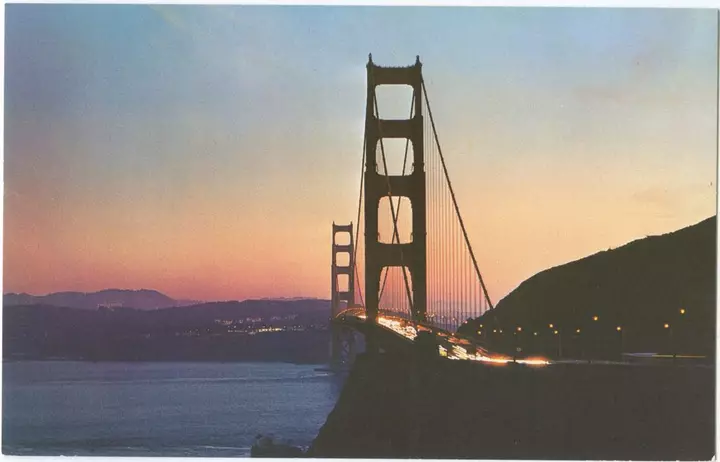
Search for the Golden Gate Bridge, let’s say, and the results will include hundreds of postcard photographs and other images capturing that iconic piece of infrastructure from a variety of angles and in a variety of decades, as well as — since this is the always climatically surprising San Francisco we’re talking about — under a variety of weather conditions. The same exercise would prove equally illuminating for Chinatown, Pier 39, the Sutro Baths (which weren’t always ruins), and the Ferry Building (which wasn’t always a collection of pricey shops). Inevitably, this sort of virtual tourism becomes a form of time travel.
DigitalSF also offers countless glimpses of San Francisco’s important periods in twentieth-century American counterculture, when the city made everything seem possible: beatnik poetry, the Grateful Dead, a particular flavor of punk, the ascent of Harvey Milk. But even before then, San Francisco had already experienced a disproportionately intense amount of history during its relatively short existence: the earthquakes of 1868 and 1906, for example, or the Gold Rush of the late eighteen-forties from whose participants the local football team took its name. Those “forty-niners” who flooded in from all over the rest of the United States, turning San Francisco from a small port town into a relatively major city practically overnight, probably had scant fascination with local history themselves.
After all, they were too busy making it. Enter the DigitalSF here. An Archive of 5,000 Images Document the History of San Francisco and the Vehicles That Put It in Motion Dramatic Footage of San Francisco Right Before & After the Massively Devastating Earthquake of 1906 How the Golden Gate Bridge Was Built: A 3D Animated Introduction Rare Footage of the “Human Be-In,” the Landmark Counter-Culture Event Held in Golden Gate Park, 1967 The Unseen Sea: San Francisco Natural Beauty in HD Lawrence Ferlinghetti Turns 100: Hear the Great San Francisco Poet Read “Trump’s Trojan Horse,” “Pity the Nation” & Many Other Poems Based in Seoul, Colin Marshall writes and broadcasts on cities, language, and culture.
He’s the author of the newsletter Books on Cities as well as the books 한국 요약 금지 (No Summarizing Korea) and Korean Newtro. Follow him on the social network formerly known as Twitter at @colinmarshall. by Colin Marshall | Permalink | Comments (0) | We’re hoping to rely on our loyal readers rather than erratic ads. To support Open Culture’s educational mission, please consider making a donation.
Extract — continue reading at the source.