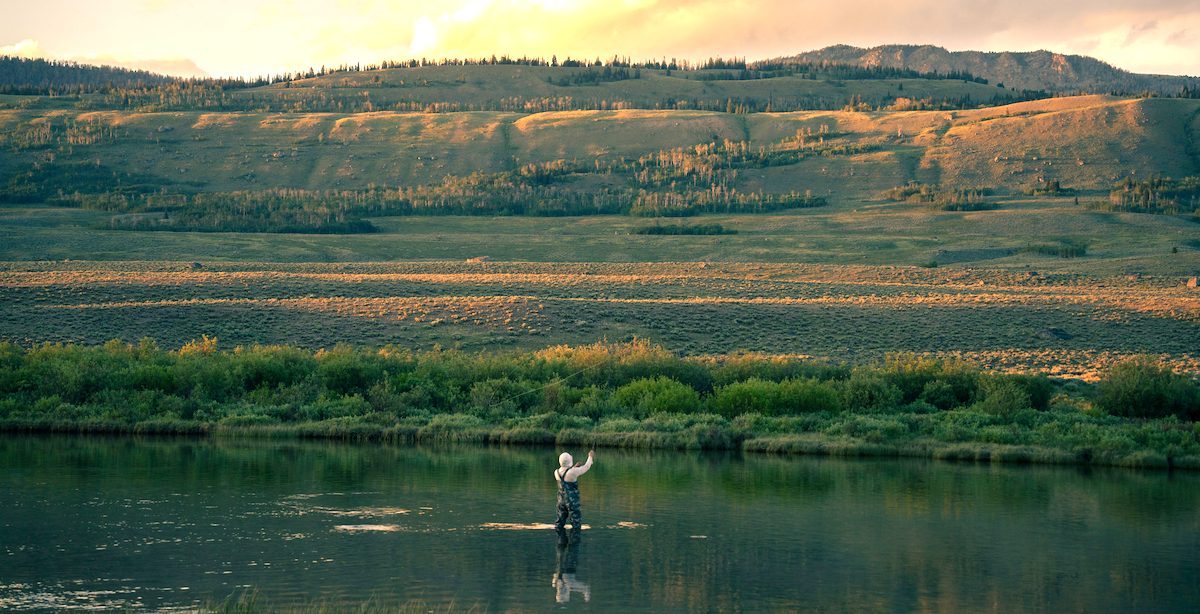
River cowboys effortlessly lassoing beautiful brown and rainbow trout. Sun-sparkled rivers chiseling valleys into mountain ranges. This is Hollywood’s version of fly fishing.
Don’t get me wrong: there’s a reason the sport is romanticized in film and television. It’s mesmerizing and set in some of the world’s most breathtaking places. No tangles for Brad Pitt, no line in trees for Kurt Russell, no hitting bottom for Kevin Costner.
They make it look easy (not to mention very male and white). But the reality—for me, at least—is that fly fishing is really, really hard. I may have married an expert and been guided by some of the best, but I’m still what might be charitably called an amateur.
The last time I went fly fishing I got stung in the eye by a wasp just as we were about to go out on the water, which had me convinced the fishing gods were sending me a message that I didn’t belong there, that I should quit while I was still barely ahead. But I went out on the water and caught nothing as my swollen face expanded. I’ve discovered that writing a novel inflicts similar harm, like the type of pain you might feel if a wasp stung you in the eye.
Until, of course, you get it right and then that pain transforms into something beautiful. Casting a fly rod, much like writing a sentence, is foundational and requires a blend of technical skill and style. Fly fishing is ostensibly about trickery—doing everything you can to trick the fish into believing your fly, that feathered, hackled bait on your hook, is real.
To achieve the appearance of authenticity out on the water every detail matters: the design of the fly, the cast, your line, and your drift. Likewise, novelists aim for verisimilitude—making the work believable through dialogue, setting, time, character development, movement, gestures, etc. When you “match the hatch” in fly fishing you’ve successfully identified the type of aquatic insect emerging from the water and matched it with one of your artificial flies.
Extract — continue reading at the source.