Flat-bodied, tiny-eyed and adapted to the murky waters of the Amazon basin, it hunts well despite having very poor vision. When a fish swims close, the frog suddenly opens its mouth and sucks the prey inside in a fraction of a second. Researchers from the University of California have recently discovered that the secret lies in its bizarre fingertips.
Each finger ends in a cluster of 16 tiny lobes, giving the frog 128 miniature sensory structures. These lobes are packed with touch-sensitive nerve endings and can detect even the smallest movements in the surrounding water. Even in complete darkness, the frog can sense a fish approaching, by holding its long front legs outstretched, with its fingers spread wide.
Despite being frogs, Surinam toads are so named because of their brown and warty skin which helps them blend into their murky environments. The animal kingdom is full of examples of where the senses have been tuned to solve a complicated problem. We tend to think of the familiar five senses as a complete package.
However, biology is much more imaginative than that. Amphibians and reptiles are particularly good at reminding us that there is far more to sensing the environment than simply seeing, hearing, smelling, tasting and touching it. Marine animals (including reptiles) have a greater need for innovative senses due to the differences caused by the physical properties of water compared to air.
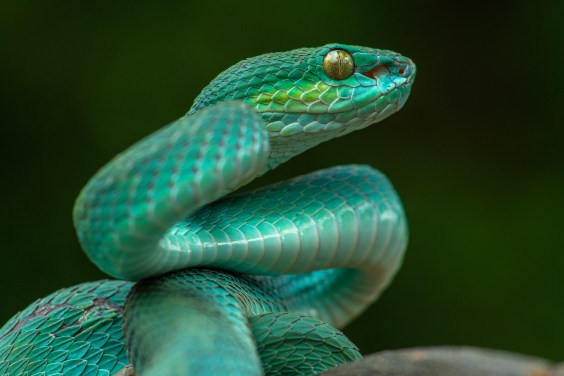
Some of their sensory abilities are modifications of familiar senses. Others detect things that humans cannot perceive at all, and some blur the boundaries between senses. One of the most spectacular examples of an unusual sense is found in several groups of snakes, particularly pit vipers, boas and pythons.
These snakes have specialised organs called pit organs on the sides of their heads, which can detect infrared radiation. To understand how extraordinary this is, imagine a mouse sitting in a dark room. To us, the mouse might be almost invisible.
Extract — continue reading at the source.



/https://tf-cmsv2-smithsonianmag-media.s3.amazonaws.com/filer_public/0e/75/0e759221-7bae-4759-ae5c-ea84bbb4b9d5/screenshot_2026-10-09_at_33437pm.png)