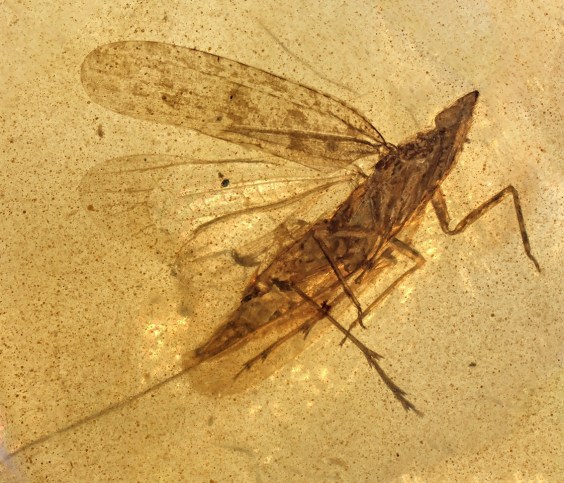
Anyone who’s seen Jurassic Park knows fossilized amber is lousy with trapped insects. While we can’t extract their juices to make dinosaurs, many of these insects are preserved in pristine detail and offer an invaluable record into what life was like tens and even hundreds of millions of years ago. Now, paleontologists have identified a new species of insect frozen in the ancient tree sap, and it’s got specialized mouthparts unlike any other insect living today.
This new prehistoric insect is a member of the order hemiptera (the true bugs) and the suborder auchenorrhyncha, which includes insects like cicadas, leafhoppers, and treehoppers. A team of paleontologists from Tel Aviv University identified the species from specimens trapped in 99-million-year-old Burmese amber, calling it Cretodorus noonoo or “Noo-Noo.” They recently published their description of the prehistoric insect (appropriately) in the journal Insects. Read more: “What Happened to the Ancient Bug Giants of 300 Million Years Ago?” The Noo-Noo’s most striking feature is its elongated proboscis, which extends more than twice its body length.
The team teased apart the structure of this extraordinary mouth tube by scanning it with high-resolution micro-computed tomography. Their analysis revealed a series of folds covering the outside of the proboscis, like the kind you might find on your vacuum cleaner’s hose. (In fact, “Noo-Noo” comes from the name of a vacuum cleaner from the children’s show Teletubbies.) According to the team, this corrugated structure allowed the tube to bend while preventing kinks that might cut off the flow. Tree sap, naturally (that’s likely how they got trapped).
Although the length of the tubule rivals that of modern butterflies and moths that drink nectar nestled deep in flowers, the researchers ruled this out. The Noo-Noos lacked any telltale pollen grains on their bodies. Instead the team believes they snaked their feeding tubes deep inside bark crevices, piercing the phloem to suck out the sap.
The tip of the structure appeared to be further specialized with two grooved lobes the researchers say likely wedged inside the vascular tissue to provide an anchor of sorts (akin to the drywall anchor on a screw). While the researchers admit this is speculative, wildfires were linked to many resin-producing forests of the period. It’s possible these trees evolved especially thick bark to survive them.
With their sugary meals farther out of reach, insects compensated with longer mouthparts. But why its fellow members of the suborder have lost this fascinating ability remains a mystery. Subscribe to our free newsletter.
Extract — continue reading at the source.
/https://tf-cmsv2-smithsonianmag-media.s3.amazonaws.com/filer_public/0e/75/0e759221-7bae-4759-ae5c-ea84bbb4b9d5/screenshot_2026-10-09_at_33437pm.png)
/https://tf-cmsv2-smithsonianmag-media.s3.amazonaws.com/filer_public/a3/8d/a38dd753-9c7e-4e71-b9ee-883308dc5d69/highresscreenshot00111_webpage-image.png)

/https://tf-cmsv2-smithsonianmag-media.s3.amazonaws.com/filer_public/dd/6f/dd6f5dc1-1cfb-4de1-ac62-ea52fffeaaf4/gettyimages-2298735670.jpg)