It’s all of that and more, like the ability to walk upright. Bipedalism is a hallmark trait of our genus, but the particulars of how we got on our two feet are the subject of some debate. For example, Australopithecus, one of our earliest ancestors, could walk upright, but it’s unclear how often they chose this method of locomotion.
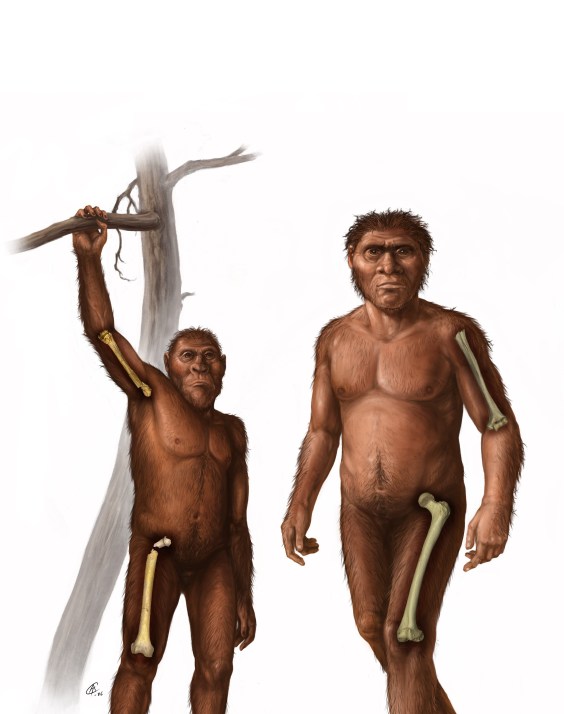
Now, a new study in Science Advances is offering some fresh clues. A team of evolutionary biologists compared the bones of the 3.7 million-year-old Australopithecus specimen dubbed “Little Foot” with Homo specimens from much later (around 1.8 million-years-old). Using CT scans, they were able to calculate the thickness of the arm and leg bones (both thighs and shins).
Because bones can grow or shrink with repeated use or disuse, bone thickness can serve as a proxy for activity or strength. Read more: “Neanderthals: Do a Little Art and Take a Stroll on the Beach” They found that Little Foot had arms that were relatively stronger than its thighs, similar to a tree-dwelling ape. But interestingly, its lower limbs showed a unique pattern with no modern analogue.
The relationship between the strength of Little Foot’s thigh and shin bones was closer to modern humans. The bones of the ancient Homo specimens, on the other hand, were closer to modern humans. According to the team, it’s a strong sign that by 1.8 million years ago, our ancestors had left the arboreal lifestyle behind for good and committed exclusively (or primarily) to walking on two feet.
Accordingly, they propose relative limb strength represents such a fundamental shift it should be considered a “threshold trait.” Still, what caused this commitment to terra firma remains a topic of heated debate. According to the researchers, it could be the need to range farther afield, the freedom to gather different food sources, or other pressures. There was a lot going in the evolution of our human ancestors during this period, and the team also notes that brain size ballooned at around the same time.
It’s possible that freeing up the hands for something other than branch-hanging played a role. We hope the possible relationship between changes in limb use, ranging behavior, and brain size will stimulate further discussion.” Enjoying Nautilus? Subscribe to our free newsletter.
Extract — continue reading at the source.