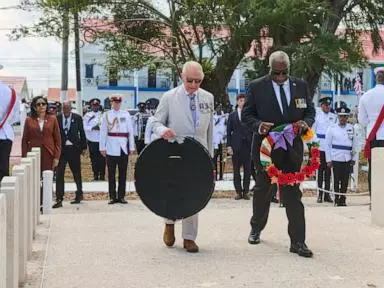
Prime Minister Andy Burnham has expressed openness to formally apologizing for Britain's role in the trans-Atlantic slave trade LONDON -- Prime Minister Andy Burnham has said he is open to making a formal apology for Britain's role in the trans-Atlantic slave trade, a significant shift in the U.K.'s position in a long-running debate on whether — and how — the country should right the wrongs of its past. Ahead of his meeting with Commonwealth leaders in the Caribbean this week, Burnham said it is the “right thing to do” to have an honest conversation about the legacies of slavery instead of “sticking our heads in the sand.” While he rejected calls for the U.K. to pay reparations, Burnham proposed leading a program of debt restructuring to help the poorest countries in the Commonwealth, an association of 56 independent nations that grew out of the British Empire. His stance received a cautious welcome, but the thorny issue of repayments remains unresolved.
At its height, Britain was the world’s biggest slave-trading nation and transported more than 3 million Africans across the Atlantic. The U.K. has never formally apologized for its role in the trade, though some British institutions including the Church of England have started to own up to the parts they played. Goods were traded in West Africa for captured slaves who were shipped across the Atlantic to work on British sugar and tobacco plantations in the Caribbean and the Americas.
Goods produced in the so-called New World were transported back to England. In the 17th century, the Royal African Company, established under King Charles II and run by his brother, who later became King James II, trafficked 80,000 African men, women and children to slavery in the Americas. About 20,000 died before the company's monopoly on the English slave trade ended in 1698, when any Englishman could trade slaves.
An abolitionist movement arose in England in the late 1700s, supported by Quakers, some politicians and former slaves. U.K. politicians have traditionally focused on the country’s role in banning the slave trade in 1807 and outlawing slavery throughout the British Empire in 1833. But Burnham said it is now time for the country to face up to the other side of the story.
For decades, Caribbean countries have demanded reparations from Britain. Studies estimate Britain would owe between hundreds of millions and trillions of dollars in compensation to descendants of slaves. Burnham rejected the idea, in keeping with previous U.K. governments.
Instead, he said he will work with other wealthy nations and investors to help poorer countries repay their high levels of debt over a longer period and at lower interest rates. Burnham said he is bringing in former Prime Minister Gordon Brown to help with this work. King Charles III, who is on a nine-day visit to the Caribbean, acknowledged “the great suffering and injustices of the past" this week.
Extract — continue reading at the source.