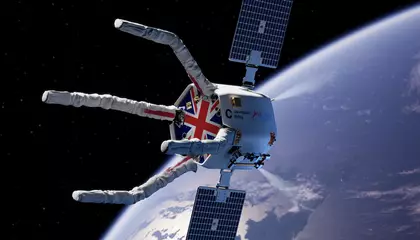
Satellites are cluttering Earth orbit, and the defunct ones are considered human-made junk. Now, the United Kingdom is developing a first-of-its-kind mission to clean up after its space program that could pave the way toward a long-term strategy for mitigating the risks of space debris. The U.K.’s Active Debris Removal (U.K.
ADR) mission aims to send a refuelable spacecraft with giant robotic claws into Earth orbit to grab two dead satellites and fling them into our planet’s atmosphere, where they will burn up, according to a government statement. The spacecraft is slated to launch from Scotland in 2029 and will be built by the U.K. branch of ClearSpace, an in-orbit servicing company. ADR mission is expected to be completed by 2032.
Space Minister Liz Lloyd says in a ClearSpace statement. Space Agency has launched a competition to name its trash-disposal mission. The public can enter suggestions until December 10, 2026.
Around 1,000 working satellites orbited Earth in 2019, but the number has skyrocketed in recent years, Jonathan McDowell, an astrophysicist who recently retired from the Center for Astrophysics, Harvard & Smithsonian, told Smithsonian magazine’s Dan Falk last year. As of late October, nearly 17,000 active satellites are circling our planet, according to the tracker SatFleet Live. More than 11,000 of the active satellites—around 66 percent—belong to the satellite internet service company Starlink, part of SpaceX.
But there’s much more than satellites above our heads. In fact, there are almost 32,000 trackable objects larger than about four inches. That means that roughly half of those objects are space debris, things like spent satellites, defunct rockets and even bits of paint.
Ideally, this junk eventually falls into Earth’s atmosphere, where it completely disintegrates from intense pressure and friction. But not all of it does so in a timely manner. Some bits of junk date back to the Cold War, whether it’s communication satellites or spy satellites or whatever stuff going back 40, 50, probably even 60 years, in some cases.
Extract — continue reading at the source.