Florida botanist Lilly Anderson-Messec can quote the English poet John Donne by heart. She says a piece of her dies every time a native Florida plant goes extinct. That perspective extends to a small carnivorous plant she first saw in 2014 while botanizing in the Florida Panhandle.
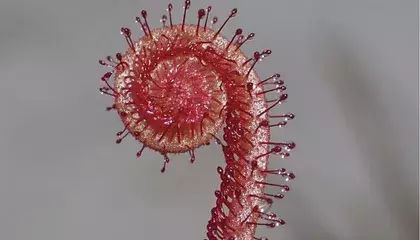
Its dazzling red thread-like leaves ending in tightly coiled spirals left her stunned. Unique it was. The insect-killer was classified at the time as a variety of the widespread thread-leaved sundew (Drosera filiformis). But Anderson-Messec was not convinced.
For one, the closest population of the thread-leaved sundew was hundreds of miles away in South Carolina. In 2024, Anderson-Messec posted a video of the rare sundew to her Instagram, speculating that it might be its own species. By then, the brilliant red sundew had already caught the attention of a 17-year-old hell-bent on bringing order to the chaotic world of carnivorous plants.
Noah Juve—now an undergraduate at the University of Florida—did just that in August 2026, publishing a description that elevated the Florida threadleaf sundew (Drosera floridana) to species status. With the help of Andreas Fleischmann, curator at the Munich Herbarium in Germany and co-author of the paper, Juve spent years comparing the sundew directly against its closest relatives at over 100 sites across the Gulf and Atlantic coasts. The work illustrated just how special floridana is through its striking red color, unique seed shape, flower morphology and bloom time. But one detail overshadowed them all.
This sundew occurs only in a 12-by-16-mile patch of the Florida Panhandle, an area smaller than Chicago, earning it the unwanted title of the most range-restricted sundew in the United States. Now, scientists and conservationists are racing to protect this limited habitat before it becomes irrevocably damaged—or destroyed entirely. Describing the species and its range restriction was crucial to advocating for its conservation, Fleischmann says.
Juve puts it more simply. The oldest carnivorous plants The oldest fossils of carnivorous plants are at least 34 million years old, uncovered from Baltic amber and described in 2014. Sundews are famous for their slow-motion death hug.
Extract — continue reading at the source.