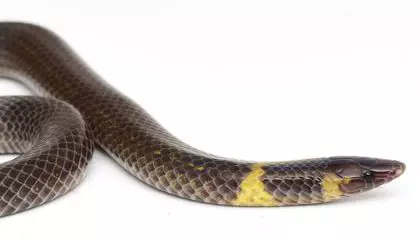
Dwarf reed snakes spend much of their time hiding under rocks, logs or leaf litter, trying to avoid being eaten. But when these small, slithering creatures feel threatened, they’ve perfected a unique method of fleeing from danger: cartwheeling. Scientists first described this roly-poly behavior several years ago, based on observations of a snake spotted wheeling itself down a road in northwest Malaysia.
Now, a different team of researchers says they have figured out how these diminutive snakes pull off the acrobatic feat. Their findings were described in a study published on October 19 in the journal Current Biology. Dwarf reed snakes (Pseudorabdion longiceps) are short, slender, nocturnal snakes that live in Southeast Asia.
They grow to a maximum length of nine inches. Despite their petite stature and penchant for hiding, they’re still vulnerable to predation from birds and other snakes, including the striped coral snake. Researchers had heard anecdotal tales of dwarf reed snakes cartwheeling away from danger.
In August 2019, they finally caught the unusual behavior on camera. A group of scientists was conducting surveys for other species when they stumbled upon a dwarf reed snake crossing a road. They apparently startled the creature, because it curled its body into a coil and began rolling downhill away from them.
Intrigued, the researchers carefully caught the snake, placed it on a flat area and brought out a camera. Once again, the snake rolled away—this time without the help of gravity. Scientists described that encounter in the journal Biotropica in 2023, marking the first time cartwheeling had been formally observed in any snake or reptile more broadly.
Ecologist Yosuke Kojima of Toho University in Japan heard about this strange behavior seven years ago from a colleague in Malaysia, reports Science News’ Maria Temming. And after seeing it for himself, Kojima was “amazed by the dynamic movement and immediately wanted to learn more about it,” he tells Defector’s Sabrina Imbler. So, Kojima and colleagues went to Malaysia’s Kubah National Park and gathered several snakes belonging to the Pseudorabdion genus: one P. longiceps, one P. collaris and 11 P. saravacense.
Extract — continue reading at the source.