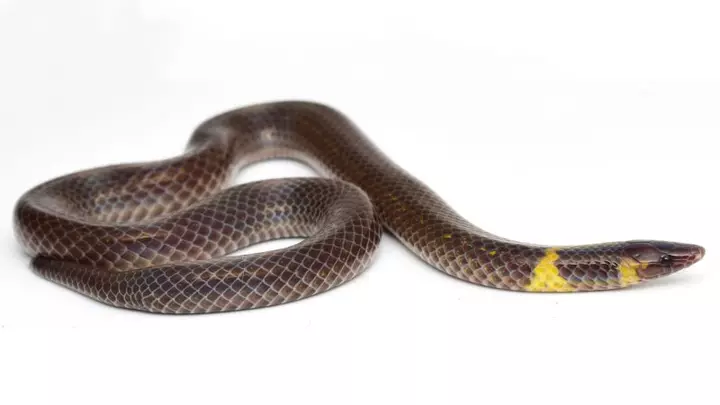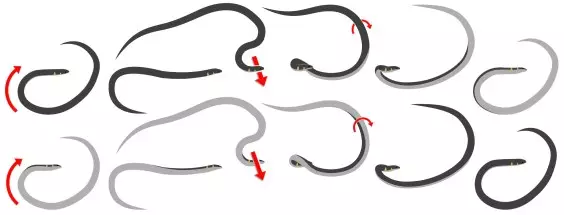
Dwarf reedsnakes of the genus Pseudorabdion, found in Southeast Asia, have a rather clever way of fleeing from trouble: They turn cartwheels until they’re safe from danger. See for yourself: Now, researchers have finally figured out how they do it, studying the action on video from multiple angles. Very precise, coordinated body movements keep the head of the snake stable and facing the direction of travel, while the rest of its body rotates.
This gets around the main issue with rolling as a way of locomotion, as you’ll know if you’ve ever gone headfirst down a hill: It’s a real challenge to see where you’re going and keep traveling in the same direction. The faster the speed, the more difficult it gets, which isn’t ideal when you’re fleeing from predators. Read more: “This Snake’s Tail Has a Fake “Spider” at the Tip” With this method, snakes can move approximately 8 mph—four times faster than they can get around using traditional wriggling, and significantly faster than the average human jogger.
Here are the particulars behind the movement: The part of the snake’s body in contact with the ground rolls and lifts the anterior portion of the snake, including the head, until the tip of its tail is the only part touching the floor. The tail then pushes off into a new loop, and the cycle continues. This isn’t the normal way of getting about for the dwarf reedsnake, but it does seem to come into play when they need to escape something in a hurry.
In fact, the researchers say the snakes tended to dive underneath nearby objects for extra cover after rolling. We wouldn’t recommend such cartwheels when making your own quick getaways, though. Unless, maybe, you’re Buffy the Vampire Slayer.
Subscribe to our free newsletter. Lead Image: Kojima et al., Current Biology, 2026
Extract — continue reading at the source.