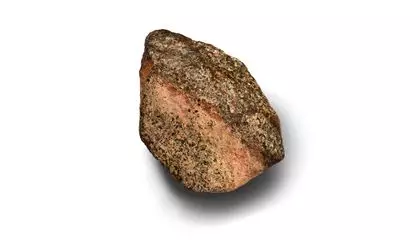
In 2022, a strange, rosy stone was discovered in the Sahara Desert. Now, scientists have found that the nearly two-pound object is a Martian meteorite made of rock that formed at least 4.1 billion years ago. The findings, published October 29 in the journal Science, mean it’s one of the oldest known samples of Mars and can help researchers better understand what the Red Planet was like in its youth.
Scientists know of more than 400 Martian meteorites. These pieces were ejected from the Red Planet when impactors hit the celestial body. The debris was flung toward Earth, passed through our atmosphere without completely burning up and then landed on the planet’s surface.
Previously, only two meteorites provided snapshots of a young Mars, which formed around 4.5 billion years ago: Allan Hills 84001, dated at 4.1 billion years old, and Northwest Africa 7034, which contains fragments dated at more than 4.3 billion years old. To figure out the age of the Sahara meteorite, called Teghaza 001, Liu and colleagues looked at the zircon crystals within it, which contain the element uranium. Researchers often date rocks by examining the decay of uranium into lead.
The team also analyzed different forms of the elements rubidium and strontium in the meteorite, which yielded a similar age estimate. Teghaza 001’s age isn’t its only special feature. Unlike the other two oldest known Martian meteorites, the rosy space rock’s composition of volcanic minerals reveals that the fragment was originally a bunch of magma.
It cooled and hardened into part of Mars’ outermost layer, the crust, and was further transformed by underground water, according to chemical analyses. This evidence of the meteorite’s past interactions with water joins a growing body of research indicating that Mars—now a dry, dusty world—was once a much wetter place. Earlier this month, the Japan Aerospace Exploration Agency launched a spacecraft to recover samples from Phobos, one of Mars’ moons.
Because Phobos may have gotten sprayed with Martian dust when impactors hit the Red Planet, researchers hope the samples contain bits of Mars. Mars’ past watery environment is one reason that researchers think the planet could have hosted life long ago, since all known organisms need water. However, they “do not directly answer the question of whether there was life on Mars.” The researchers say Teghaza 001 likely came from Mars’ Noachian southern highlands, since the meteorite’s chemical makeup matches what NASA’s Mars Reconnaissance Orbiter has observed there.
Extract — continue reading at the source.