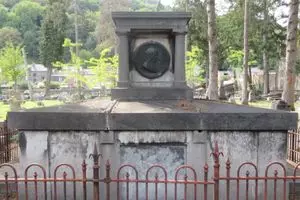
Tucked away in an unassuming cemetery lies the grave of Georges Nagelmackers, the founder of the Compagnie des wagons-lits (and thus, of the Orient Express). The front view of the grave. Georges Nagelmackers’s epitaph is at the bottom left. duaner / Atlas Obscura User Entrance of the Cimetière de la Diguette (with the grave visible through the door open). duaner / Atlas Obscura User The front view of the grave.
It is a one-hour-and-15-minute drive west of Brussels. The area itself is not particularly interesting; it is a residential neighbourhood located between Sart-Tilman Hill and the railway lines in the Ourthe Valley. However, visitors may be surprised to discover two castles amongst the houses: Château Péralta and Château Nagelmackers.
The latter was purchased in the 19th century by the renowned Belgian banking family Nagelmackers. They also donated a plot of land in 1864 to create the town’s new cemetery, the Diguette Cemetery. It is therefore no surprise to find the family grave there.
The engineer and industrialist Georges Nagelmackers is among the family members buried there. He founded the Compagnie Internationale des Wagons-Lits and the original Orient Express. However, achieving this success was far from plain sailing.
In fact, things got off to a rocky start: in 1867, his father sent him to the United States to hide away after he expressed his desire to marry his cousin. During his time there, he became interested in Pullman's night trains, and to develop the idea further, he also gathered feedback from passengers with a view to creating an improved version. He returned to Belgium convinced he had a brilliant idea.
However, as soon as he returned, he was put in charge of the family's blast furnaces and mine. While working there, he developed his project and, in April 1870, published an explanatory brochure in which the term 'sleeper carriages' ("wagon-lit") appeared for the first time. Unfortunately, the Franco-Prussian War broke out in July 1870, dashing any hopes of bringing the project to fruition.
Extract — continue reading at the source.