Developing meaningful and effective cognition-oriented treatments to enhance cognition and dementia prevention is a major public health need. This online randomized controlled trial assessed the effects of a new web-based cognitive training platform, the Breakfast Game (BG), which simulates real-life executive control/multitasking demands. Participants were randomized into 1) experimental group: BG using the Emphasis Change (EmCh), a strategy to facilitate flexible attention allocation, or 2) active control group: BG without EmCh.
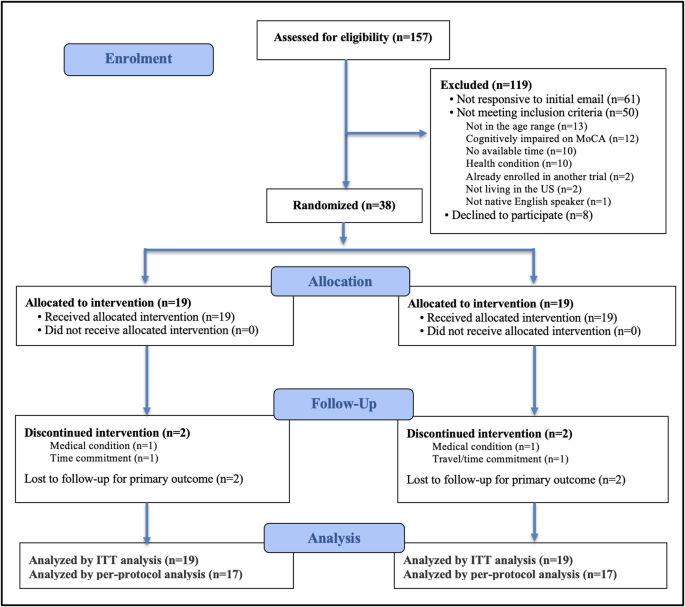
Thirty-eight cognitively unimpaired older adults, highly educated (mean 16.4 years) and mostly White (78%), were included in the study. Participants underwent pre- and post-assessments with 12 intervention sessions, three times per week. The intent-to-treat approach and linear-mixed models were implemented, and all models controlled for baseline performance.
Both groups improved the game performance over the sessions, but the EmCh presented significantly greater improvement. There were time-by-group interactions in the game metrics and near-transfer outcomes on multitasking and executive/attention control, indicating greater training gains and transfer effects in the EmCh group. There were no distant-transfer effects on self-efficacy, mood, or cognitive activities in daily life.
The BG with the EmCh is a promising online intervention tool to promote cognitive health and enhance executive control / multitasking abilities in aging. The relevance of a cognitively active lifestyle to cognitive health and dementia prevention has been well documented by large observational studies1,2,3,4,5, lifestyle interventions6,7,8, and research on cognition-oriented treatments (COT), which includes different approaches such as cognitive training9,10,11,12. Evidence suggests that greater cognitive engagement in everyday life may attenuate cognitive decline1,2,6,12, and lower the incidence of mild cognitive impairment4 and dementia in older adults3,5,11.
For instance, cognitive-stimulating leisure activities have been shown to reduce the risk of dementia over five years, even after adjusting for education and cognition at baseline5. Furthermore, the ACTIVE trial11,12, a large randomized controlled trial (n > 2800 participants), showed 10-year benefits of cognitive training in cognitively unimpaired older adults, including maintenance of cognitive performance, less functional decline in instrumental activities of daily living12, and lower incidence of dementia in 29% of participants11. Together, these findings underscore the critical public‐health impact of implementing a cognitively active lifestyle and engaging older adults in effective COTs to promote cognitive health, quality of life, and dementia prevention, potentially enhancing reserve and resilience in late life13,14.
Randomized controlled trials of COTs with older adults have shown cognitive training benefits in the short-term15,16,17,18,19,20,21,22 and long-term11,12,21. Nevertheless, systematic reviews indicate a scarcity of high-quality evidence on the benefits of cognitive training in cognitively unimpaired older adults, including heterogeneous methodology (e.g., target, dose, measures), mixed results, and inconsistent transfer effects9,23,24,25,26,27,28,29,30,31,32. These comprehensive review data suggest that not all cognitive training protocols present the same benefits, and a need for more innovative and accessible protocols in the field.
Extract — continue reading at the source.


