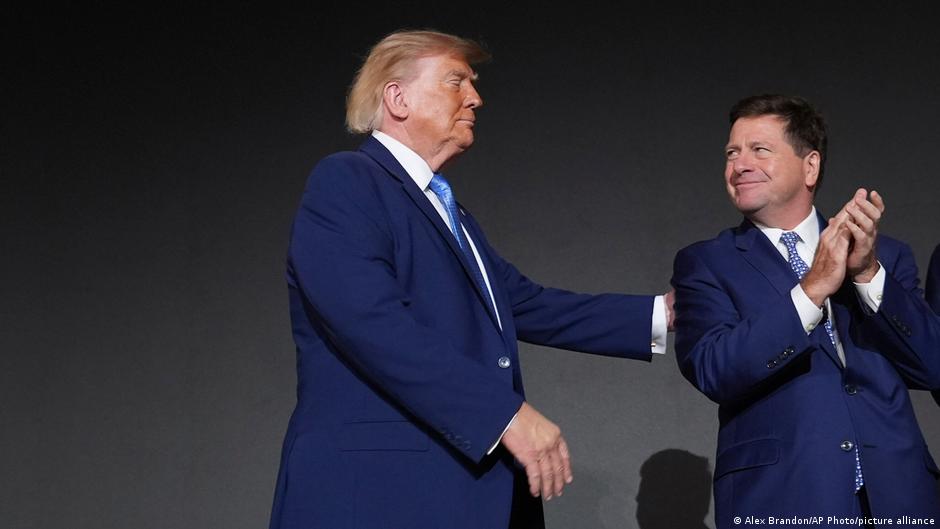
"Bigger than the Industrial Revolution and the internet" — US President Donald Trump used a comparison borrowed from "many others" to describe artificial intelligence (AI) in his announcement of a "Super Intelligence Force." The president's move to address the rapid development of the AI industry came after he met with top AI executives at the end of September — and a month before midterm elections in November. Trump has faced intensifying pressure and warnings from business and political leaders about the mostly unregulated technology. The name echoes Trump's September executive order renaming "Artificial Intelligence" as "Super intelligence" (SI).
Jay Clayton, the director of national security and the president's new AI czar, is the task force leader. The task force will coordinate the government's effort "to ensure that America continues to lead the World in Super Intelligence," Trump said, and "will protect the interests, and improve the lives, of all Americans." To view this video please enable JavaScript, and consider upgrading to a web browser that supports HTML5 video Trump has made it clear he does not want regulation to "stifle" progress in the SI industry, and a reported charter for the group says it will work to prevent "overregulation and regulatory capture." The White House has not released any information about the Super Intelligence Force, but a copy of a charter detailing the group's responsibilities was reported in The Wall Street Journal and Politico. The reported document shows the task force's scope is broad, but it names biosecurity and threats to the water supply as areas of focus.
Recent cyberattacks have targeted critical infrastructure in the US. The group is to work with some of the most important US government agencies, including the Pentagon, the Justice Department, the Department of Homeland Security and the Federal Trade Commission (FTC), to develop recommendations for new laws to improve government responses. A legal requirement for AI labs to notify the government of "breaches, hacks and jailbreaks" is to be considered, as well as the potential for automatic alerts.
"Though the labs are ultimately responsible for the risks and opportunities that their models amplify and accelerate, it is the role of the federal government to recognize and understand this era of change and to enforce our nation’s laws so that the fundamental principles of our Republic are safeguarded and advanced," the reported document says. The charter's remit includes financial services, energy infrastructure, transportation, agriculture and emergency services. Trump said the task force would coordinate the government's engagement with consumers, public interest groups and religious organizations, as well as critical infrastructure providers and AI companies, though some critics noted the omission of workers.
The task force has 120 days to deliver a report on the risks of AI, focusing on potential threats to civil liberties, cybersecurity, standards for advanced models and the impacts of possible overregulation. Clayton, whom Trump named AI czar in early October, is to chair the task force. He told The Wall Street Journal he expected AI mechanisms to be "developed in dialogue," citing risk models the Securities and Exchange Commission, which he headed during Trump's first presidential term, and the Federal Reserve developed for the financial industry.
The reported charter also named three task force vice chairs: Ferguson is expected to oversee consumer interests and advocacy groups, according to the reported charter. His inclusion comes as the FTC investigates OpenAI, Anthropic and METR over rogue AI agents with potentially nefarious agendas. Michael, a former tech consultant who sat on Perplexity AI's advisory board, is to oversee coordination with AI companies.
Extract — continue reading at the source.