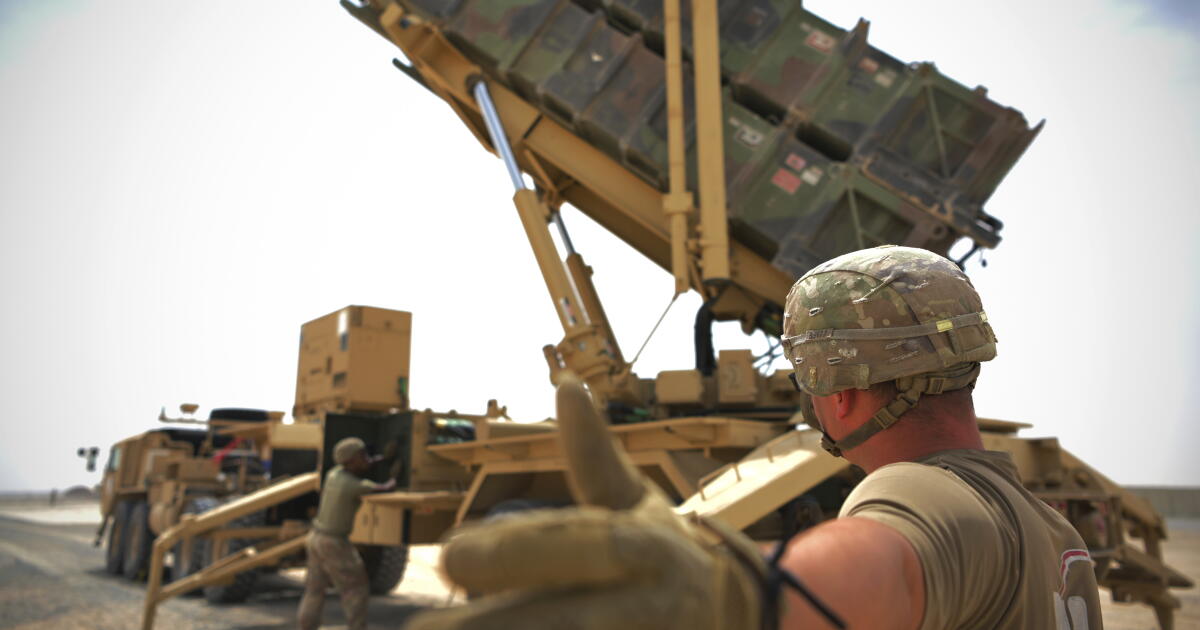
The statistics are sobering — so sobering that Defense Department officials refuse to confirm, deny or discuss them. From Feb. 28 through July, the first five months of the war with Iraq, U.S. forces burned through almost 60% of the nation’s advanced defensive missiles — the Patriot and THAAD interceptors that protect American troops. When the war began, the Pentagon had almost 2,800 Patriot and THAAD missiles in its worldwide inventory, according to a study by the Center for Strategic and International Studies, an independent think tank.
By the end of July, that number had dropped to about 1,100, CSIS reported. Almost two-thirds of the Patriots and almost 40% of the longer-range THAAD were gone. That’s true, but misleading.
The U.S. military still holds vast inventories of short-range offensive missiles. But the sophisticated defensive missiles that protect U.S. troops no longer are abundant — as even Trump has acknowledged. For much of August, when a frayed de facto ceasefire was in effect, U.S. forces did not respond with high-end missiles when Iran attacked oil tankers in the Strait of Hormuz.
But when Iran launched rockets against U.S. bases in Jordan last week, Patriots reportedly were used to knock the incoming missiles down. (The Pentagon has declined to confirm or deny those reports.) The U.S. weapons arsenal “no longer has the capacity to deter a Chinese attack against Taiwan,” the Council on Foreign Relations warned in a report last month. Defense planners share the same concern over a potential Russian assault on the Baltic states. The conservative Heritage Foundation has forecast that the Pentagon’s inventory of missiles would run out “within the first week of a Taiwan conflict.” In Europe, a U.S. defense official told the last month that the shortfall was “beyond critical.” If Russia attacked a NATO country, the official said, U.S. forces in the area would “take punch after punch in the mouth.” The core question is whether the United States has so few missiles that it cannot credibly deter China or Russia from attacking their neighbors.
But ramping up missile production won’t immediately replenish the stockpile. Before the Iran war, defense contractors were producing only about 620 Patriots and 96 THAAD each year — fewer than half the number expended during a few weeks this spring. At current production rates, it will take at least three years to return the Patriot inventory to its prewar level, and at least four years for THAAD, CSIS reported.
Defense experts warn that the stocks need to be even larger than they were before the war to credibly deter China or Russia. Mark Cancian, a retired Marine colonel and principal author of the CSIS estimates, says most analysts believe it will take years after replenishing the stocks expended in the Persian Gulf to build a credible deterrent against China. The Pentagon has enough munitions, both offensive and defensive, to continue fighting the campaign against Iran, he added — but some of those less-sophisticated weapons can be used only at shorter ranges, which means placing more troops in harm’s way.
Extract — continue reading at the source.