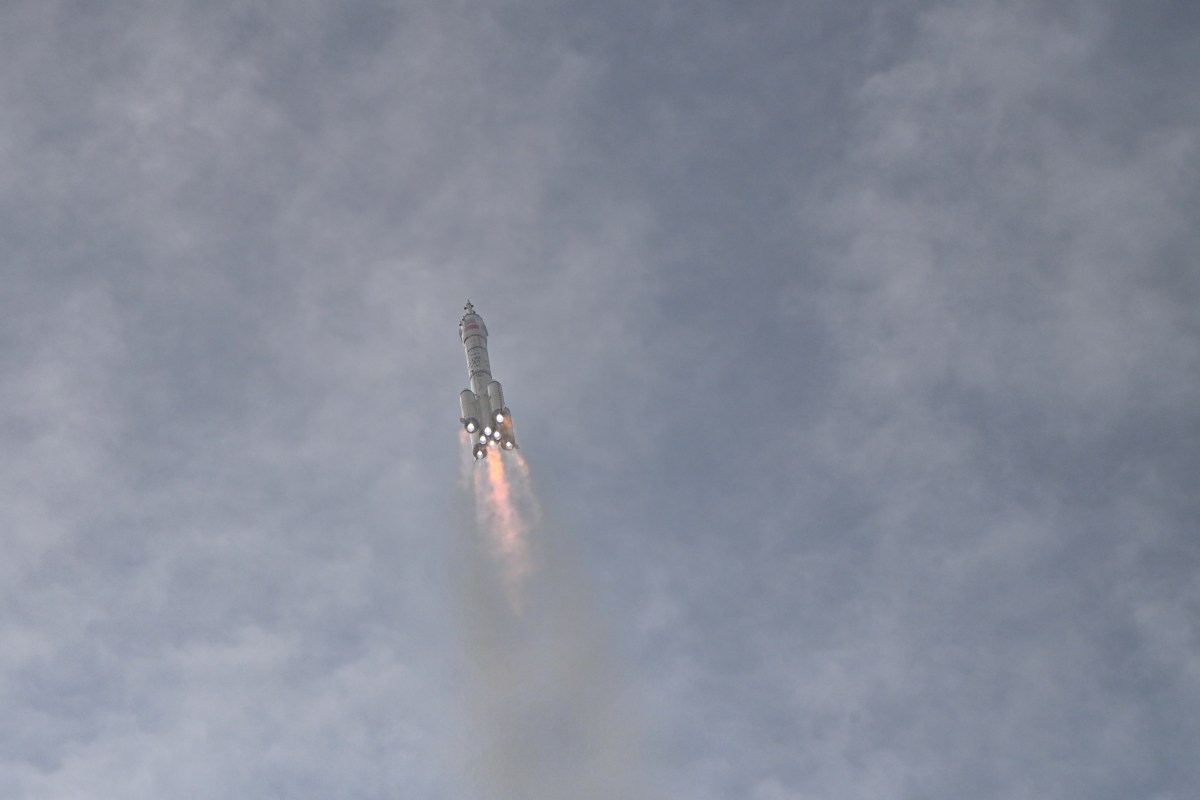
The U.S. has deployed a weapon in Earth’s orbit in a move that has raised the prospect of an accelerating space arms race with Russia and China. Secretary of the Air Force Troy Meink on Monday told the Air, Space and Cyber Conference that the "on-orbit" weapon was needed to protect U.S. forces against hostile enemy action. The U.S, Russia, and China, however, have explored other means of weaponry outside of the treaty, such as targeting the satellites of adversaries to hurt their military communications, surveillance and navigation capabilities.
U.S. officials have thus far been tight-lipped about U.S. space weapons, so Meink’s statement marks a significant shift in rhetoric from Washington. President Donald Trump issued an executive order in December 2025 that emphasized the U.S. Space Force's role in both defending assets and serving as an attacking force.
The Trump administration has also said space-based capabilities and interceptor missiles were key to its planned "Golden Dome" defense system to protect the U.S. from airborne threats. However, Meink did not offer any details about the weapon's capabilities or when it was launched into orbit. This lack of additional details means that "anything is on the table,” Swope said.
Space Force spokesperson said in a statement on Monday that space control “encapsulates the mission areas required to contest and control the space domain.” The statement also referred to “kinetic and nonkinetic means to affect adversary capabilities through disruption, degradation and even destruction, if necessary.” However, Swope said since it is not known what the weapon is, its destructive potential is unknown either which adds to the mystery of its value as a deterrence. Space Force issued a space threat fact sheet in 2024, which, by its latest update in July 2026, describes how China and Russia are testing and fielding sophisticated counterspace capabilities with the aim of disrupting and degrading U.S. space-enabled capabilities. The fact sheet says China is developing space and counterspace capabilities in a military modernization strategy to achieve “strategic decisive victory, strategic counterbalance, and strategic deterrence and control over the U.S. military in the Indo-Pacific region.
China’s People’s Liberation Army (PLA) sees space as playing a key role in future conflicts by enabling long-range precision strikes and denying other militaries the use of space-based information, it added. China completed 37 orbital launches through June, boosting its total on-orbit payloads to 1,506, and is targeting 140 launches in 2026—which would be a 52 percent year-over-year increase. The PLA has 510+ ISR-capable (intelligence, surveillance and reconnaissance) satellites with optical, multispectral, radar, and radiofrequency sensors that can detect U.S. aircraft carriers, expeditionary forces, and air wings, according to the U.S.
As of June 1, China had launched 200 G60 and 168 SatNet communications satellites in low Earth orbit which were part of two planned mega constellations to compete with Western variants. China is also working to master reusable space launch, he said. Russia conducted only 17 launches in 2025—short of the 26 or more annual launches it averaged from 1995 to 2015—and remained absent from the international market, launching roughly 10 foreign payloads, according to the U.S.
Extract — continue reading at the source.