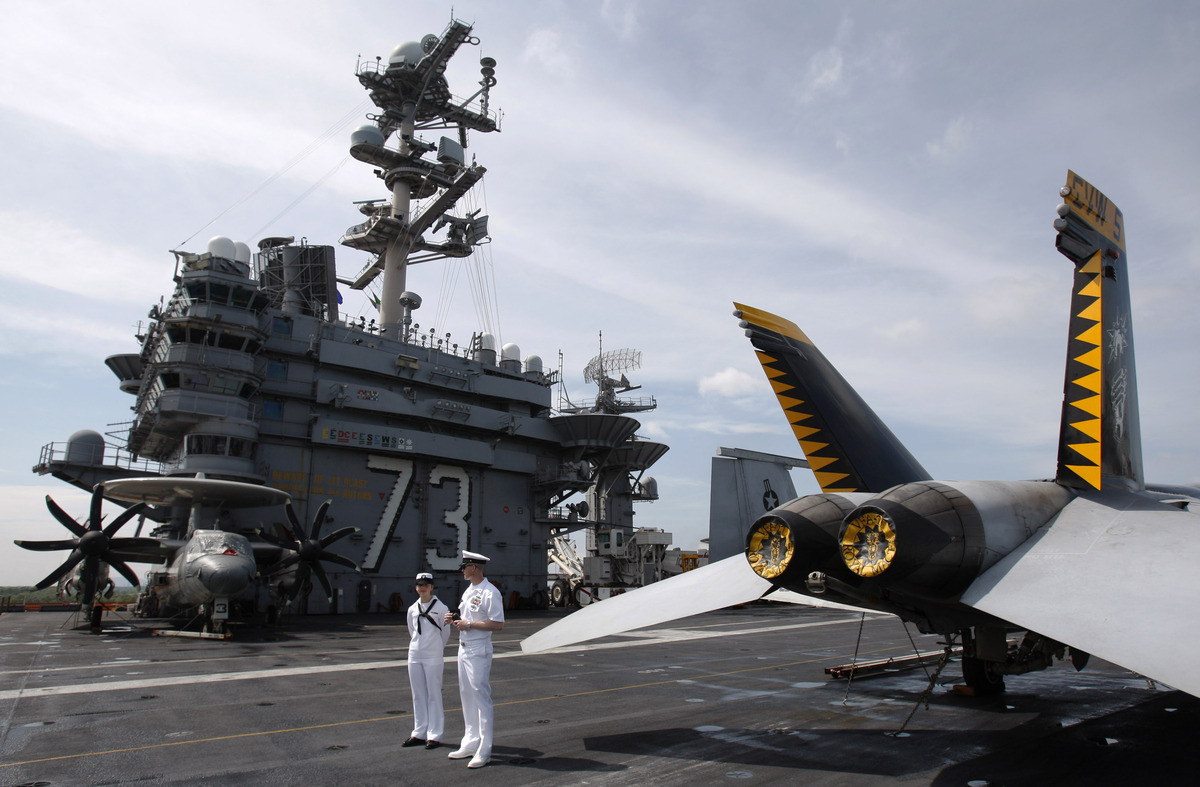
Moving the USS George Washington from the Pacific to the Middle East will pose a "national security risk" to the United States, a former commander on the aircraft carrier has said, as the final carrier deployed in Asia becomes the latest U.S. Navy ship to be sucked into the war with Iran. The George Washington is expected to relieve the crew of the USS Abraham Lincoln.
The Lincoln has found itself the focus of Democratic calls for investigations into reports of dwindling supplies and poor mental health among the roughly 5,000 sailors and Marines who have not set foot on land since December, which has put fresh attention on living conditions aboard U.S. They also raised concerns that the U.S. Navy, while powerful, is overly stretched by the months of war in the Middle East and not prepared enough for a potential future confrontation with China.
Redeploying the Washington to the Gulf will leave the U.S. "with limited naval presence" for over a year and a half, because the carrier will return for a maintenance stint once it's finished in the Middle East, said retired Rear Admiral Mark Montgomery, a former commander of Carrier Strike Group 5 aboard the Washington who also headed operations for the U.S. "This is a national security risk as it sends a weak deterrence message to China and does not assure Americas allies and partners in the Pacific," Montgomery, who is now with the Washington, D.C.-based Foundation for Defense of Democracies think tank, told Newsweek.
The White House referred queries to the Pentagon, which doesn't comment on topics it says would compromise operational security. Navy referred questions to the U.S. Pacific Command, which Newsweek has contacted for comment via email.
President Donald Trump and his administration have signaled to U.S. allies that their defense spending must surge so the U.S.'s forces can be freed up to meet the threat posed by China's burgeoning, sophisticated military. The White House, while insisting it's focusing on the Indo-Pacific, has piled pressure on Japan, Taiwan and South Korea to invest in their militaries and has often rattled officials in their capital cities. Trump abruptly scaled back planned U.S. military drills with South Korea on Sunday, just hours before wargames largely focused on how to tackle North Korea kicked off.
The president said the exercises, which Pyongyang condemned, were "totally inappropriate and hostile” to North Korea while also blaming the eleventh-hour change on Seoul's unwillingness to join the U.S.'s war against Iran. In May, Trump worried Taiwanese lawmakers by appearing to use weapons sales to Taipei, which are vital for Taiwan's armed forces, as a bargaining chip with Chinese President Xi Jinping. Beijing considers Taiwan, a self-governing island since 1949, to be a breakaway part of China and has pledged to bring the territory back under its control, including by using military force.
Extract — continue reading at the source.