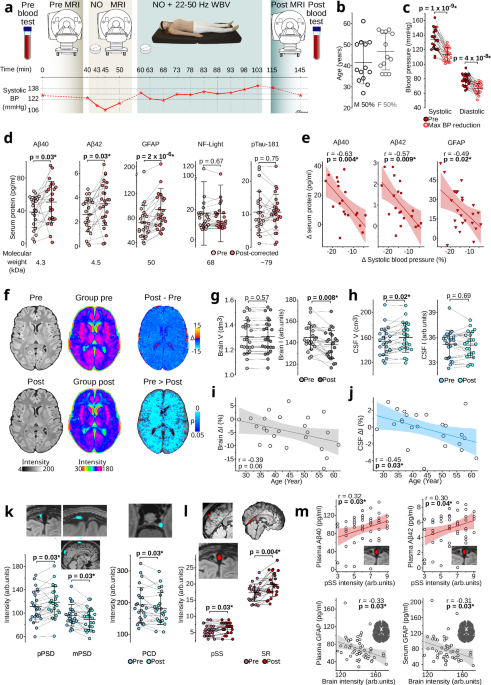
An age-related neurovascular impairment in nitric oxide (NO)-mediated vasodilation and reciprocal Piezo1-dependent vascular vasoconstriction may precede the accumulation of soluble brain proteins such as amyloid-β (Aβ) and disruption of brain fluid homeostasis in Alzheimer’s disease (AD). Preclinical studies suggest that restoring these pathways can enhance neurofluid transport and improve cognitive outcomes. In this study (EudraCT 2021-000625-27), we investigated the effects of sublingual NO and Piezo1-targeted whole-body vibrations (WBVp) in healthy adults (n = 29) using multimodal neuroimaging and blood biomarker analysis.
The combined intervention (NO+WBVp) was associated with correlating changes in brain fluid dynamics and increased blood levels of soluble brain-derived proteins (Aβ40&42, GFAP). These effects increased with age and the magnitude of NO-induced hypotension. The interventions were well tolerated under controlled experimental conditions.
Overall, the findings are consistent with transient redistribution of brain-derived proteins toward circulation, suggesting a potential non-invasive approach to increase neurofluidic solute efflux in humans. Pre-specified primary endpoints, changes in circulating brain-derived protein concentrations, brain fluid imaging and brain pulsation measures, were met. Secondary outcomes included physiological analyses.
The efficient removal of soluble metabolites and proteins from interstitial and cerebrospinal fluids (I/CSF) is essential for maintaining brain homeostasis. Impairment of brain clearance pathways has been linked to the earliest stages of neurodegenerative disease, preceding neuronal loss by years or decades1. Experimental and clinical studies demonstrate that impaired clearance of soluble amyloid-β (Aβ) and phosphorylated tau protein from the CSF leads to their accumulation within perivascular and interstitial compartments, promoting their aggregation and accelerating neuropathology1,2,3,4,5,6.
For example, a murine model of Alzheimer’s disease (AD) exhibits progressive perivascular Aβ deposition accompanied by loss of endothelial low-density lipoprotein receptor-related protein 1 (LRP1), a key transporter mediating Aβ efflux to blood5. Elevated soluble Aβ concentrations within CSF further impede perivascular transport, creating a feed-forward cycle in which Aβ transport becomes increasingly impaired5,6. Therapeutic strategies that can safely enhance CSF solute clearance therefore represent a promising approach to delaying or preventing the onset of neurodegenerative disease.
Recent findings suggest that CSF efflux can be modulated through physiological mechanisms that are both therapeutically targetable and monitorable in humans. Acute systemic vasodilation caused by hypotensive drugs such as nicardipine and sodium nitroprusside (SNP) has emerged as a potent enhancer of CSF solute efflux in rodents7. Nitric oxide (NO) donors such as SNP increase movement of intracisternal tracers from the cranial cavity to the blood, predominantly via cervical lymph nodes, an effect that is accompanied by improved downstream lymphatic function7,8.
Extract — continue reading at the source.