The human cerebrovasculature is a critical yet historically understudied component of neurological health. Dysfunction of the diverse endothelial, mural, and perivascular cells that comprise cerebral vessels is central to diseases ranging from stroke to Alzheimer’s disease. However, characterizing these cell populations at a molecular level has proven exceptionally challenging.
Encased within a robust basement membrane, vascular cells resist standard dissociation methods, leading to their systematic depletion and underrepresentation in existing single-nucleus genomic atlases. This has created a major blind spot in neuroscience. To overcome this barrier, we developed vessel isolation and nucleus extraction for sequencing (VINE-seq) and its advanced iteration, MultiVINE-seq.
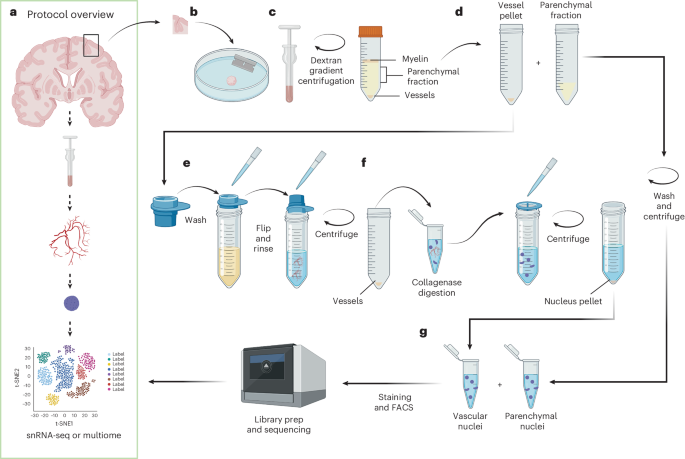
The protocol provides a robust, reproducible workflow for the enrichment and high-resolution profiling of vascular, perivascular, and immune cells from fresh or frozen human and mouse brain tissue. First, intact vessels (predominantly capillaries and small arterioles/venules, 100 µm in diameter) are isolated from homogenized brain tissue via dextran-based density-gradient centrifugation, separating the vascular pellet from myelin and the parenchymal fraction. Second, the collected vessels are rigorously washed over a cell strainer to remove trapped contaminants.
A critical innovation lies in the third stage: the optimized extraction of nuclei from purified vessels using enzymatic digestion. After extraction, the protocol uses fluorescence-activated cell sorting (FACS) to ensure collection of high-purity nuclei suitable for widely used droplet-based sequencing platforms (e.g., 10x Genomics single cell 3′ or multiome). This protocol requires 4–5 h to complete and can be carried out by researchers with single-cell and flow cytometry training.
Fresh or frozen human or mouse brain tissue is homogenized, and intact vessels are isolated via density centrifugation. Vascular nuclei are enzymatically extracted from washed vessels using collagenase III digestion. In parallel, parenchymal nuclei are recovered from the density gradient.
Both vascular and parenchymal nuclei are purified by FACS, ensuring high purity and compatibility with single-nucleus RNA sequencing (snRNA-seq), single-nucleus assay for transposase-accessible chromatin with sequencing (snATAC-seq) and multiomic workflows. This is a preview of subscription content, access via your institution Access Nature and 54 other Nature Portfolio journals Get Nature+, our best-value online-access subscription Receive 12 print issues and online access Prices may be subject to local taxes which are calculated during checkout Raw sequencing data for VINE-seq are publicly available on the National Center for Biotechnology Information (NCBI) Gene Expression Omnibus repository under accession number GSE163577, and raw sequencing data for MultiVINE-seq are publicly available in the NCBI Sequence Read Archive (SRA) under BioProject accession number SRA: PRJNA1182356. Any additional information in this paper is available from the corresponding author upon request.
Extract — continue reading at the source.


