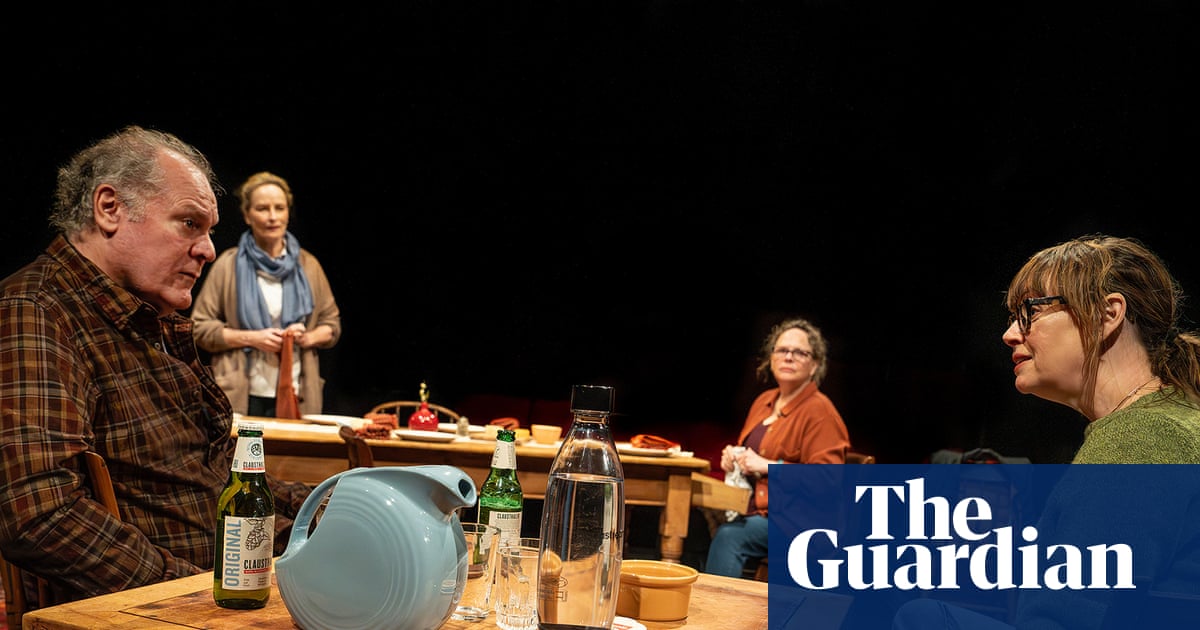
Richard Nelson learned a great lesson, cliched as it is, late in his writing career: the thing you toss off without overthinking can end up being some of your life’s greatest work. In the program notes for We’ll See, the latest in what has become a 12-play series, he admits he used to view the plays as “disposable, because of their being tied to a given time and place”. Every November from 2010–2013, Nelson checked in on the fictional Apple family in upstate New York during elections and important national anniversaries, with each play set on the day of its premiere and mostly starring the same cast. (We’ll See, which opens this week at the Public Theater, sees them awaiting the results of the midterm elections.) “I totally thought four was it, and I was content with that,” he says.
But the head of Berlin’s Schaubühne theatre happened to catch them in 2013, when the Public presented all four in repertory, and suggested Nelson bring them overseas. But when I saw the reaction, the reaction was visceral. I learned the lesson that the more specific you are, the more universal you can be.” The plays were then broadcast on television, toured globally, and Nelson spun off two other family cycles also set in Rhinebeck, New York, where the writer-director has lived since 1982, allowing him to take national temperature checks throughout the first Trump administration.
Barely a month after Covid shut down live theater, the Apple family popped up in a Zoom trilogy, allowing the works – known as the Rhinebeck Panorama – to reach even wider audiences. And I seem to have a way of doing that. I already had the characters: Where were they now?” In the age of mass displacement and gentrification, and amid Nelson’s travels, We’ll See has migration on its mind, and an outside-in mentality.
Nelson builds the plays from his extensive note-taking, which allows his characters’ opinions on culture or politics to feel organic – an extension of his own everyday observation. Near the beginning of We’ll See, a family member mentions having stumbled upon the 19th-century folk song No One to Welcome You Home (“It had been in my notebook for a long time”), prompting a discussion about the town’s recent ICE raids. When conversation turns to Ukraine (where Nelson often works), a character brings up an anecdote about a Ukrainian actor with startlingly different back-to-back interactions during her time in New York: someone took care of her bill as a show of empathy, another hurled xenophobic insults.
Both are true stories Nelson had been told, and also reflect his recent experiences abroad. Though one of the characters suggests that maybe the country is “no longer burdened by being special”, Nelson thinks that exceptionalism is “a simplistic slogan”, at least as it pertains to his plays. You need to have those feelings to feel the pain and the loss and the sorrow of when they’re being taken away or abused.” By focusing on a family, he says, “you’re not dealing with presidents and leaders in a fantasy political world,” but rather the complexities of the individual.
What these plays are trying to do is not trivialize a human being. There’s no possibility of that kind of rampant exceptionalism because it’s too complicated.” Sixteen years into the series, Nelson says he can hear his characters and instinctively know where they’ll stand on certain issues. In 2026, the Apple family is dealing with retirement (both chosen and forced), cancer and downsizing, and he says “all of that connects to what they’re thinking, politically, socially, culturally, morally”.
Extract — continue reading at the source.