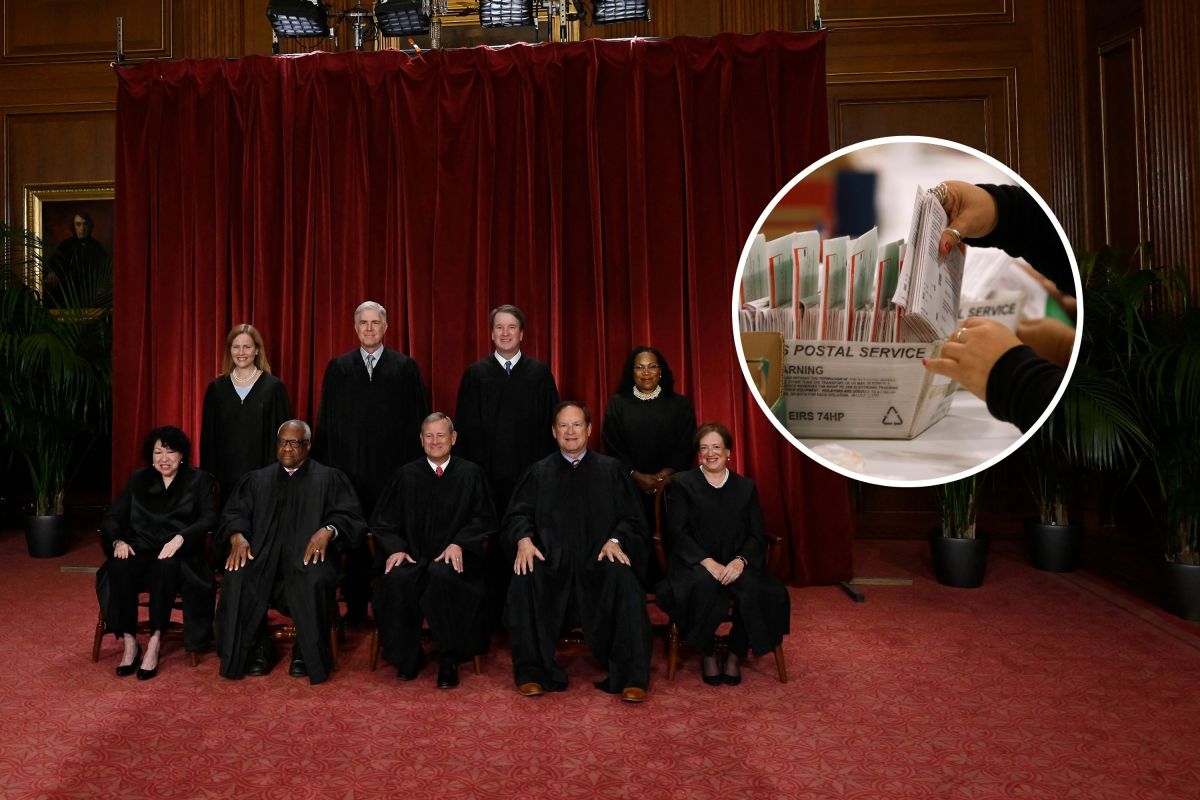
The Trump administration asked the Supreme Court on Thursday to lift a lower court order blocking new Postal Service restrictions on mail-in ballots, setting up a fight that could reach the justices for the third time in six weeks just as the first ballots for November's midterms go out. The request targets a temporary restraining order issued by U.S. District Judge Indira Talwani in Boston, who found that election officials would face "irreparable harm" if forced to comply with the rule for the 2026 midterms, calling compliance "practically impossible" with the election two months away.
The Supreme Court has asked for a response by September 8. The case has already produced one surprising break from ideological lines this year, and legal experts say the individual justices' records on mail voting offer a mixed picture of how they might rule on the president's latest request. The clearest signal so far came in June, when the Supreme Court ruled 5-4 in Watson v.
Republican National Committee that federal law does not bar states from counting mail ballots that arrive after Election Day, as long as they were postmarked on time. Justice Amy Coney Barrett wrote the majority opinion, joined by Chief Justice John Roberts and Justices Sonia Sotomayor, Elena Kagan and Ketanji Brown Jackson. Barrett wrote that election day statutes require the electorate's choice to be made on election day, but do not set a deadline for ballot receipt.
Justice Samuel Alito dissented, joined by Justices Clarence Thomas and Neil Gorsuch and in part by Justice Brett Kavanaugh, arguing that letting ballots arrive after Election Day risks undermining public confidence in election integrity. Kavanaugh has staked out a consistent position on mail ballot deadlines since 2020, when he wrote in a concurrence in Democratic National Committee v. Wisconsin State Legislature that states want to avoid the chaos that can come from thousands of absentee ballots arriving after Election Day and potentially flipping a result.
He has also invoked what is known as the Purcell principle, the doctrine that courts should avoid changing election rules close to a vote, in filings related to the current dispute. Sotomayor and Kagan dissented from the Supreme Court's August 24 order lifting an earlier injunction against the president's executive order, along with Jackson. Sotomayor wrote that the ruling did not address whether the administration's attempts to interfere with state election administration are lawful, and did not suggest the executive branch has constitutional or statutory authority to implement the president's directives.
Jackson wrote separately that the decision needlessly injects chaos and uncertainty into the midterms. "It's quite possible we get a district-court ruling issuing a preliminary injunction today, which would moot the current Supreme Court appeal on the TRO," Richard Hasen, director of the Safeguarding Democracy Project at UCLA School of Law, told Newsweek. A new stay request would likely follow, he said, first to the U.S.
Extract — continue reading at the source.