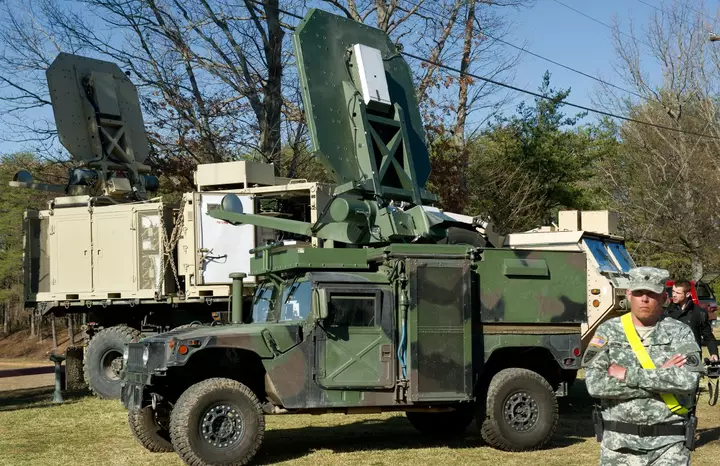
Defense Secretary Pete Hegseth has given the Department of Homeland Security (DHS) permission to test a nonlethal heat ray weapon for possible use combating illegal immigration across America's southern border. The Republican politician reportedly signed a memo in September which gave DHS permission to test the Active Denial System (ADS), which fires invisible electromagnetic waves that are absorbed close to the skin’s surface, producing a burning sensation compared to "an intensified version of opening an oven." It is on the U.N. Special Rapporteur on Torture’s prohibited equipment list and deploying it on the southern border would likely trigger renewed discussion about border security and human rights.
President Donald Trump has made combating illegal immigration across the U.S.-Mexico border one of the main policy priorities of his second term in office. In a statement to Newsweek, a U.S. Customs and Border Protection (CBP) spokesperson said: "CBP is continually evaluating new technology, especially technology that can save lives while simultaneously enhancing national security effectiveness." DHS referred Newsweek to the CBP statement.
A Pentagon spokesperson referred Newsweek to DHS when approached for comment. The ADS is a vehicle-mounted energy weapon that produces electromagnetic waves around 95 GHz. Work on the technology was launched in the late 1980s by the U.S.
Air Force, with the ADS established as a demonstration project from 2002 to 2007. These waves, that are invisible to the naked eye, can be directed at targets around 1,000 meters away, according to the U.S. military. The beams are designed to be absorbed close to the skin’s surface, at depths of 0.3 to 0.4 millimeters, causing a rapid rise in temperature.
This triggers sensory nerve endings called nociceptors, producing what one Air Force technical sergeant called "an intolerable heating sensation on the skin." Speaking in 2007, Staff Sergeant Jason Delacruz, an ADS operator, said: "The pain is comparable to an intensified version of opening an oven and feeling the initial blast of hot air. "The effects are extremely sudden, and natural instincts automatically force you to quickly exit the target area." The military says the intense heating sensation stops when the beam is switched off or the person moves out of its path. Residual tingling or tenderness can last up to 15 minutes, according to a Pentagon account of a 2012 demonstration.
Thus far, the ADS has not been actively deployed in either a combat or policing capacity. ADS is not intended to cause long-term damage, such as serious tissue injury, but there have been reports of second-degree burns and health concerns have been raised by groups, including the OHCHR. According to Axios, in 2007 an airman received burns from an ADS after it was misused during a training exercise, though they made a full recovery.
Extract — continue reading at the source.