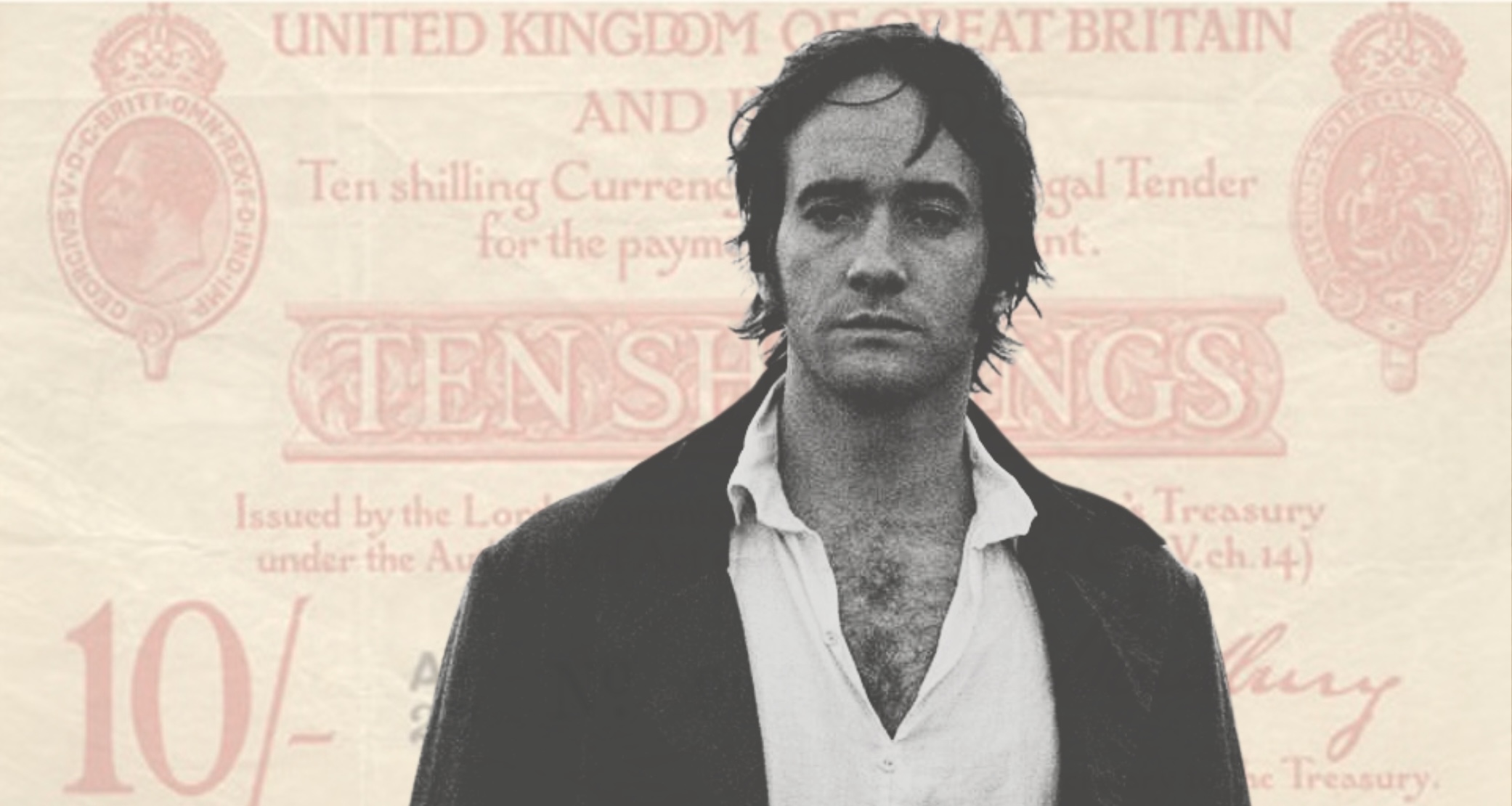
Many readers are perplexed by Austen’s habit of indicating men’s fortunes in terms of annual income, while women’s fortunes are expressed as a lump sum. Darcy has an estate of £10,000 per annum, for example, while Emma Woodhouse has £30,000 to her name. Among the landed gentry, men’s fortunes were usually put to work on an estate, and their capital was not liquid.
Just as in earlier feudal society, their income was based on the crops and rents that their land could generate. Females with dowries, meanwhile, generally had little control over their money, and the capital was invested, often in government bonds. During the time Austen was writing, many men and women with funds but no landed estate would invest them in naval bonds, which averaged 4%-6% interest per year during the Napoleonic wars, depending on naval success. (Austen called them “the Navy fives” when that was their expected rate of return.) Those of us outside Great Britain struggle to understand even the basics of British currency before it was decimalized.
In Austen’s time, the units were guineas, pounds, crowns, shillings, and pence (or pennies). Most of these had a fixed ratio: 1 pound sterling (£) = 4 silver crowns = 20 shillings (s.) = 240 pence (d.). Pence were further subdivided: A single penny (1d.) = 2 halfpennies = 4 farthings.
Farthings were the smallest unit of money, amounting to one-quarter of a penny. There were thus 960 farthings in a pound. A crown was worth 5 shillings, or one-quarter of a pound.
Confusingly, guineas were worth slightly more than pounds, in Austen’s time around 21 shillings. The value of guineas was based on the cost of gold relative to silver. Austen uses most of these terms in her novels, so much nuance is lost without knowing their relative worth.
It’s important to note that the economy of Austen’s day differed so much from ours that it is impossible to translate their annual income directly to modern purchasing power. Banknotes could be written for any amount and were similar to, but much less uniform than, today’s paper money. Regency banknotes were essentially promissory notes underwritten by a specific bank.
Extract — continue reading at the source.