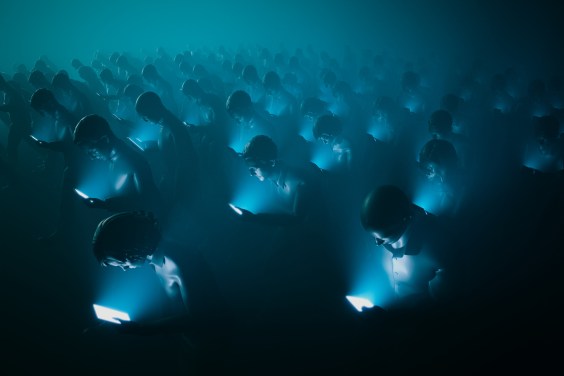
Our digital age presents a paradox, says Icelandic sociologist Vidar Halldorsson. Though humans are more connected and accessible to one another in a global and immediate way, our ability to actually bond with one another using all of the senses is eroding. With our handheld supercomputers at the ready, we are less connected to one another in the end, not more.
This is not a new idea, but Halldorsson has coined a new term he calls “social magic,” the tiny signals and exchanges of energy and empathetic connection that come from being in a physical space with another human being and which help to build a society. Facial micro-expressions, body language, spatial proximity, and even smell all carry social information, he says. French sociologist and father of social science Émile Durkheim might have called this “collective effervescence,” the sense of being part of something larger than oneself.
Read more: “How to Feel at Home in the Modern World” Halldorsson hangs responsibility for the loneliness, polarization, anxiety, and hate of our current era in large part on how screens have come to dominate every facet of daily life. So many activities we used to do in physical spaces with others are now available at the press of a button from home: grocery shopping, taking in a movie, sports watching, even religious practice. Halldorsson recently published a new book, How Digital Screen Use Alienates Human Societies: A Treatise on Social Magic and its Decadence.
In it he argues that we need to bring back social magic. I spoke with him about team sports, human adaptation, and how we might revive cultures of collectivism. Much of your research has focused on the psychology of athletes and team sports.
Do you see any direct relationship between that work and the subject of your new book, screens and loneliness? I’m mostly interested in social atmosphere, the energy which emerges when people gather from a social psychological point of view. Iceland was famous eight years ago when the men’s soccer team qualified for the World Cup.
We are a population of 350,000, making us one of the smallest nations ever to qualify, so it got us some attention. The reason why Iceland did well was not because we had great players, it was because we had teams that become something more than the sum of the parts. Because of the social energy, because of the social magic.
Extract — continue reading at the source.
/https://tf-cmsv2-smithsonianmag-media.s3.amazonaws.com/filer_public/2c/1c/2c1cb4b9-d775-4091-b0ab-15c69ec5e325/natalie_veekmans_this_is_my_best_side.jpg)