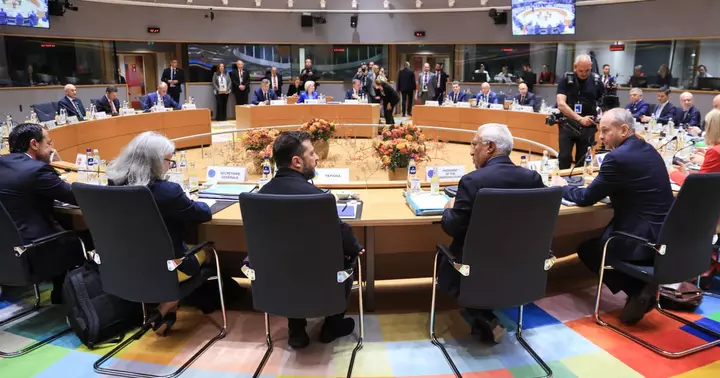
This was supposed to be an EU summit about the EU’s long-term budget. But things are never easy for EU leaders, and world events have a nasty habit of making their way onto the itinerary. That meant this European Council had a lot more on the agenda than the last handful of summits, at least: Energy, migration, enlargement, Ukraine, and more besides were covered — and very little, if anything, was decided.
Have FOMO because you weren’t there? Don’t worry, we’ve got you covered. Here’s POLITICO’s rapid roundup of what we learned at the European Council.
The summit’s first major clash came Thursday morning, with EU leaders split over whether to delay ETS2, the bloc’s second phase of carbon pricing, to address high energy prices, triggering a three-hour-long standoff. Italy and Greece joined the Visegrád Four — Czechia, Hungary, Poland and Slovakia — in calling for a delay, a push rejected by the majority of countries. The debate dragged on, delaying lunch (spare a thought for our hungry leaders!) and leading to the cancellation of a press conference on Thursday night.
Negotiations on the bloc’s next long-term budget were expected to be one of the summit’s most contentious topics. But they were a nothingburger, with most leaders repeating positions they have held for months. The summit brought them no closer to a breakthrough.
Many countries, of course, want a smaller budget, with Swedish Prime Minister Ulf Kristersson telling reporters that his country is “not an ATM for the EU.” Belgian Prime Minister Bart De Wever, meanwhile, said he had no choice but to be frugal at the European level, arguing he is used to tightening his belt at home because his wife is Dutch. Think of Bart next time your Dutch friends ask you to pay them back for that coffee. European Council President António Costa is still aiming to get a budget deal before the end of the year, according to two EU officials.
He announced that leaders will hold a special summit at the end of November to try and make progress (and there’s a December summit too). But that timing leaves them up against the clock to reach a deal by year’s end. If leaders do hope to agree on the EU’s long-term budget this year, they should prepare for long negotiations in November and December.
Extract — continue reading at the source.