The printing press was invented in the middle of the fifteenth century, and it’s been downhill for the written word ever since. Even before then, arguments that the volume of writing being done far outstripped the value of that writing surely weren’t unheard of. Whatever the era, the most incisive remarks on the apparent victory of verbal quantity over verbal quality tend to have come from writers themselves.
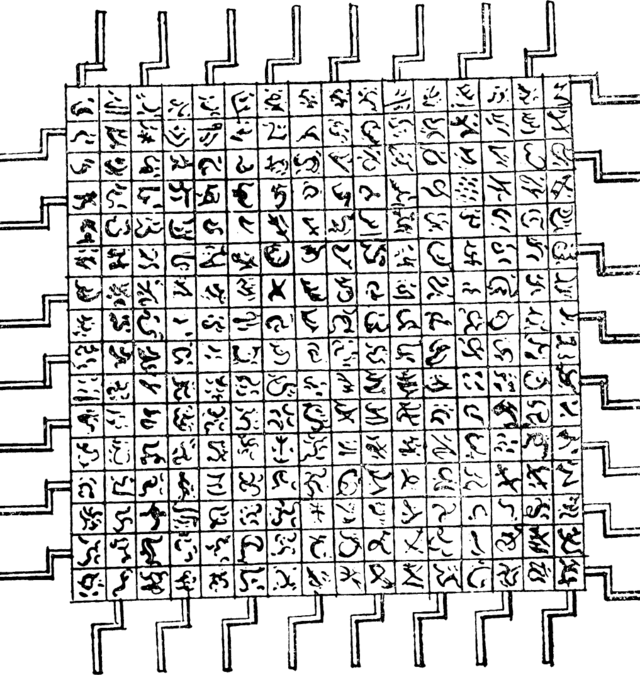
No less a satirist than Jonathan Swift made it one of his many targets in Gulliver’s Travels (1726), imagining an elaborate machine of wood and wire called “the Engine” (see illustration above) that automatically generates text, though few remember it — or rather, few remembered it until the rise of large language models in the real world. Gulliver encounters that technological marvel, the Engine, at an institution called the Academy of Projectors in the city of Lagado. Swift’s protagonist records its creator’s explanation as follows: “Every one knew how laborious the usual method is of attaining to arts and sciences; whereas, by his contrivance, the most ignorant person, at a reasonable charge, and with a little bodily labor, might write books in philosophy, poetry, politics, laws, mathematics, and theology, without the least assistance from genius or study.” The Engine’s operation, with its unwieldy, clacking components and a scrambling staff of young crankers, readers, and scribes, may strike us as bizarre, just as it did audiences in the eighteenth century.
But in our time, when students can write their papers literally without giving it a thought (to say nothing of what their professors may be getting up to), its concept now sounds all too plausible. That post dates from ten years, nearly to the day, before the launch of ChatGPT, which changed the general public’s ideas about what computers can and can’t do. We may disagree about whether a machine can truly generate “a complete body of all arts and sciences,” as the Engine’s inventor intends, but it no longer sounds like sheerest fantasy.
Swift had in mind not engineers of artificial intelligence but the Royal Society, whose enthusiasm for scientific knowledge and experimentation he saw as insufficiently tethered to reality, or at least practicality. In addition to the Engine, writes literature professor Robin Bates, “Swift imagines scientists attempting to extract sunbeams from cucumbers, soften marble into pillows and pincushions, replace silkworms with spiders (and having them eat brightly colored flies so the threads will be pre-dyed), mix paint by smell, reassemble original food stuffs from excrement, and build houses from the top down (in imitation of the bee and the spider).” His satire holds up today thanks to his understanding that, “for all the promises of the Enlightenment, the Age of Reason, and the Scientific and Technological Revolutions,” our attempts to change the world “founder the moment we start ignoring human nature.” But who needs human nature, the Projectors of today might argue, when you’ve got enough compute? How George Orwell Predicted the Rise of “AI Slop” in Nineteen Eighty-Four (1949) When Roald Dahl Wrote a Story Predicting the Rise of ChatGPT and Other AI Large Language Models (1954) Sci-Fi Writer Arthur C.
Clarke Predicted the Rise of Artificial Intelligence & the Existential Questions We Would Need to Answer (1978) Why AI Companies Are Buying — And Then Destroying — Old Books George Orwell Got a B- at Harvard, When Michael Crichton Submitted an Orwell Essay as His Own A Busy Person’s Introduction to Large Language Models (LLMs) Based in Seoul, Colin Marshall writes and broadcasts on cities, language, and culture. He’s the author of the newsletter Books on Cities as well as the books 한국 요약 금지 (No Summarizing Korea) and Korean Newtro. Follow him on the social network formerly known as Twitter at @colinmarshall. by Colin Marshall | Permalink | Comments (0) | We’re hoping to rely on our loyal readers rather than erratic ads.
To support Open Culture’s educational mission, please consider making a donation. We accept PayPal, Venmo (@openculture), Patreon and Crypto! Please find all options here.
Extract — continue reading at the source.