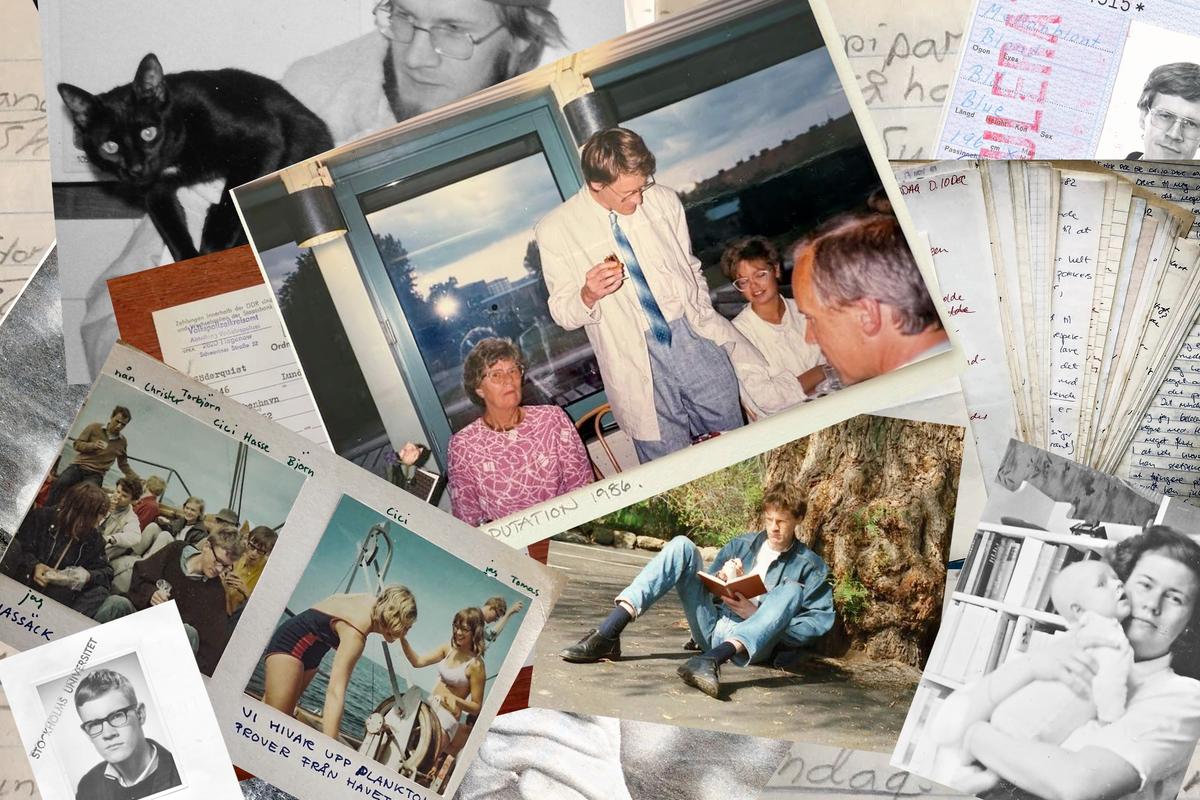
When I was about 15, alone in the flat one afternoon, I sneaked into my mother’s writing desk and found a small pocket calendar from 1946 pushed to the back of a drawer. I had grown up with my mother and her parents, not knowing who my biological father was, or how I had come about; the question was simply never asked. I turned, with a kind of dread, to the entries from nine months before I was born.
In mid-March there was an ordinary note – ‘Party at the Academic Association’; she was training as a laboratory technician in Lund and liked the students’ company – and on the following day, in her hand, five words: ‘God, what have I done!’ I still remember the shock of standing there with the diary, half-guilty for trespassing on her private papers, and saying aloud, over and over: ‘That’s me – that’s me. I’m a mistake.’ For half a century, the scene stayed as it was: fixed, private, finished. Then, about a decade ago, I posted it – to several hundred old acquaintances and strangers – on Facebook.
I was in doubt; I felt faint embarrassment at making it public, but this was itself part of what I wanted to examine. What did the shame tell me about myself? And would saying it out loud, to strangers, do anything to drain the memory of its sting?
The answers came from my readers, and one of them showed me something I could not have seen on my own. Betty, a friend from the years we were postdocs together at Stanford, had heard me tell the story in person long ago, and she said the written version was missing something: my voice, the intonation and the look on my face. What look, I asked – had I played it for sympathy, had I ironised it?
But yes, you ironised.’ I had not known that about myself: that I’d delivered the central wound of my origins with no expression at all and turned it into a dry joke. That discovery, prompted by a reader’s response, was one of the first signs that writing one’s life in public could change how memory and narrative take shape. Writing an autobiography or memoir was traditionally a solitary undertaking.
Authors worked through papers, memories and past events largely on their own, occasionally consulting family, friends or colleagues. Only after years of private work would the manuscript reach the public. Readers encountered the finished account, with little sense of the revisions, doubts and shifts in understanding that had shaped it.
Extract — continue reading at the source.