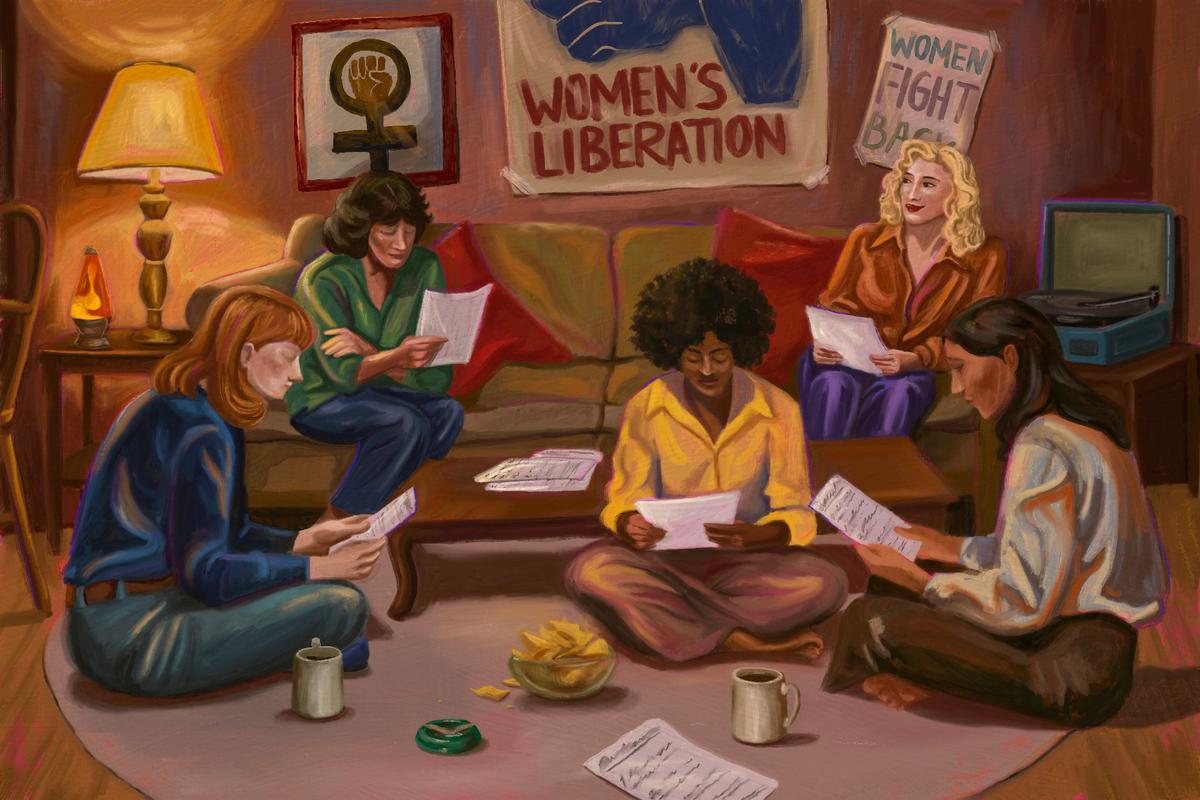
In 1972, Shere Hite, a Playboy model turned feminist sex researcher, jumped on a motorbike and drove around Manhattan. With a cascade of strawberry blonde curls peeping out under the helmet, rosebud lips visible under the visor, and a vintage lace gown streaming behind her, she handed out surveys to any woman who would take one. Across 58 questions, Hite asked: ‘Could you describe what an orgasm feels like to you?’; ‘Do you feel free to do all the things you would like [in sex], or do you think the other person(s) would be shocked?’; ‘Do you think sex is in any way political?’ The responses formed the basis of the feminist sexology bestseller The Hite Report: A Nationwide Study of Female Sexuality (1976).
It sold 50 million copies. This was among the first books that asked women how they felt about sex, rather than telling them what to feel. Its great provocation was that most American women were sexually dissatisfied: 70 per cent of them could not orgasm from penetrative sex but required clitoral stimulation; a significant proportion of women faked orgasms.
The Hite Report remains the 30th bestselling book of all time, and one of the most-read books of the 20th century. Yet today it and its author have largely vanished. By the early 1970s, the number of young women in the US who reported having had premarital sex was around 62 per cent – up from 7.6 per cent of those born before 1900.
The Pill was widely available – 10 million women were using it – decoupling sex from reproduction for the first time in history. And the introduction of no-fault divorce in California in 1969 (soon followed by other states) meant that women could more easily free themselves from loveless marriages. Into this confounding sexual revolution Shere published her Hite Report.
Hite found that the sexual revolution meant more sex for women, but not better sex. For many of the women she surveyed, sex still followed a similar and unsatisfactory pattern that one woman described as ‘a little kiss, a little feel, a finger for arousal, a touch of breast and he’s on top, wham it’s over.’ Invariably, male orgasm determined the end of sex. One woman, freed up by the sexual revolution to have many lovers, noted that ‘I’m beginning to think there must be something like a sexual “Robert’s Rules of Order” which every guy follows.’ Even Alex Comfort’s widely read book The Joy of Sex (1972) couldn’t get away from the sexual script that saw penis-in-vagina sex as the pièce de résistance. (A Black lesbian who filled out the Original Survey, on which The Hite Report was based, remarked that she ‘didn’t think much’ of Comfort’s contribution.) Women also felt that during the sexual revolution they had ‘lost their right to say “no”’.
One woman told Hite: ‘Most men didn’t give a damn about whether I wanted to have sex with them or not; if I didn’t want to screw them, they would … try to lecture me into being “free”.’ Sexual inequality percolated through the revolution. Hite’s path to feminism was unusual. While enrolled on a PhD at Columbia University in New York, she worked as a model, sometimes doing fashion jobs, sometimes porn (which paid better), and was hired by Olivetti typewriters to appear in an advertisement.
Extract — continue reading at the source.