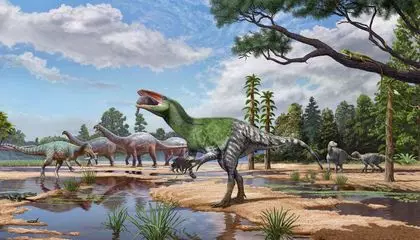
Paleontologists have uncovered a new genus and species of dinosaur from a fossil that sat overlooked in the archives of the Natural History Museum in London since 1924. Invictibellatrix amberina—whose genus name means “unconquered female warrior”—was a tiger-size, long-clawed predator that roamed what’s now southern England’s Isle of Wight some 120 million years ago. It belonged to a group of two-legged carnivores called megaraptorans and is the first known member discovered in Europe.
The findings, published in the journal Royal Society Open Science on October 14, both increase scientists’ knowledge of the types of dinosaurs that lived during this time and highlight the importance of revisiting museum collections. The fossil, a partial braincase, was found by amateur paleontologist Reginald Walter Hooley. The Natural History Museum purchased it after his death, but the specimen was never formally described until now.
So, Morrison and colleagues conducted CT scans of the fossil to create a 3D model of the skull and brain, which they then compared with fossils of other dinosaurs. Analyses revealed some distinctions in the head’s structure, such as an oval hole where the spinal cord went into the brain and an hourglass-shaped bony feature atop the skull, hinting at a new genus and species. Based on Invictibellatrix’s relatives, the researchers suspect the previously undescribed dinosaur was a small megaraptor about 10 feet long and 5 feet tall.
It may have been covered in feathers and had seven-inch-long curved claws to attack prey, such as small dinosaurs, lizards and mammals. We’re about a third of Invictibellatrix’ body weight, so if humans were around during the Early Cretaceous, we’d be “perfectly sized prey” for this dinosaur, he explains. We’d be too tiny to be worth the effort for Tyrannosaurus rex.
He and his colleagues named the new genus “unconquered female warrior” in Latin because megaraptors eventually evolved into large apex predators. The species name amberina pays homage to the amber in the geologic formation where the fossil was found. In the study, the researchers wrote a message about the genus name Invictibellatrix: “This name is to give hope and strength to all those who are bullied, discriminated, victimized and oppressed that tomorrow will be theirs and not to give up in the face of such odds.” “These findings help to uncover the evolution of one of the most mysterious theropod groups,” says study co-author Charlie Scherer, a vertebrate paleontologist at University College London, to Will Dunham at .
Scientists are still trying to piece together how megaraptorans spread globally. Many suspect the dinosaurs originated in what’s now Asia before moving into Europe, then to a supercontinent called Gondwana, which included modern-day Africa, South America, Australia and Antarctica. However, this hypothesis had long been missing important evidence: no megaraptors had been found in Europe.
Extract — continue reading at the source.