When people face losing the ability to talk, they need alternative ways to communicate. One way people preserve their voice is by banking it. The process has improved in recent years, but it still produces a voice that can sound unnatural.
Jules Rodriguez did this as amyotrophic lateral sclerosis, or ALS, left his own voice diminished. But he wasn’t happy with the sound.New technology that uses artificial intelligence allowed Jules to create a voice clone, one that sounds like his old voice. With breaths, intonations and even stutters, these voice clones capture the quirks of a human voice.
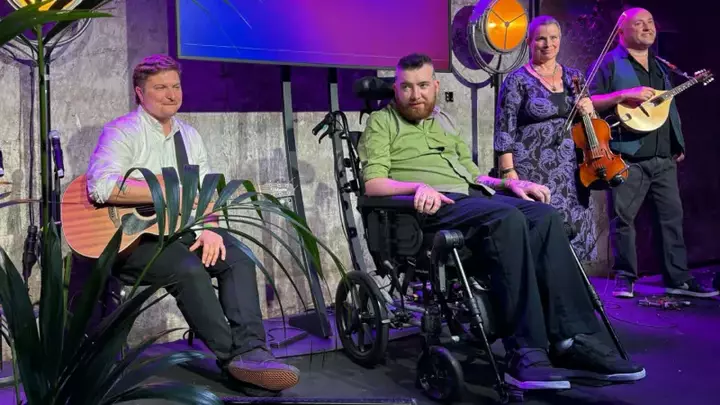
Jules’ voice clone was so realistic that his wife cried the first time she heard it. In this episode, hear how AI-powered voice clones are changing the conversation around how people connect. That includes a musician named Patrick Darling who uses his voice clone to sing and perform songs.
Laura Sanders: Jules Rodriguez’s voice was disappearing. Jules Rodriguez: For me, it felt like I was fading away, like when Marty McFly was seeing his family fade away in the picture he had in “Back to the Future.” Sanders: Jules has ALS, and like many people with that disease, this fading felt inevitable. But there was something Jules could do about it.
I’m Laura Sanders, and this is episode three of The Deep End: Talk To Me, a Science News podcast on the human voice and all it can hold. [voices] Hey mom, can I tell you something? The voice is absolutely an integral part of your identity. That added layer of it being you.
Sanders: On today’s episode, we’re going to hear about the return of Jules’ voice. We touched on this in the last episode, but as a reminder, there are a few traditional ways people preserve their ways to communicate when they’re faced with losing a voice. One is for people to record themselves saying common or special phrases if they can still talk.
Extract — continue reading at the source.