Archaeologists have discovered the remains of a Norse church in southern Greenland, a find that could offer new insights into the lives of the Vikings who once called the island home. Norse settlers from Iceland, also referred to as Vikings, first settled in Greenland around 985 C.E., led by explorer Erik the Red. They lived on the massive island until the early 15th century, when they mysteriously vanished.
As Tim Folger wrote for Smithsonian magazine in 2017, Norse settlers didn’t “just get by” in Greenland. They “built manor houses and hundreds of farms; they imported stained glass; they raised sheep, goats and cattle; they traded furs, walrus-tusk ivory, live polar bears and other exotic arctic goods with Europe.” Such success, he adds, makes their disappearance all the more perplexing. For decades, researchers have been conducting archaeological excavations in hopes of better understanding the rise and fall of Norse society in Greenland.
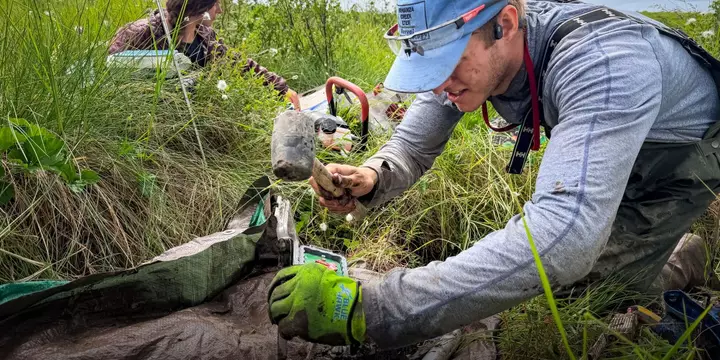
In the early 2000s, researchers discovered a rectangular stone wall with the remains of a stone building in the middle, a layout that suggests the site was once home to Norse church. But to definitively confirm the building’s purpose, they wanted to find a cemetery. In 2025, archaeologists once again revisited the site.
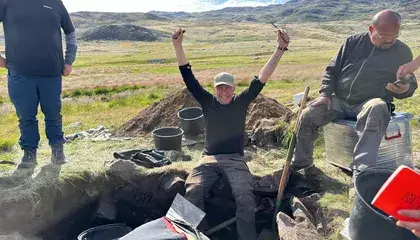
On the final day of that excavation, researchers started unearthing bits of charcoal, which suggested humans had once occupied the site. Then, they found what appeared to be a decomposed human bone. When researchers returned this past August, they uncovered the remains of an entire human skeleton buried with its arms placed by its sides and its head pointing east, a positioning that suggests a Norse Christian burial sometime during the early Middle Ages.
That would make it the first Norse church discovered in Greenland in more than 60 years. Based on its size and construction from hewn stones, the researchers suspect it dates between 1100 and 1300 C.E., a period that aligns with when Norse settlers in Greenland were transitioning to Christianity. The church is located near the modern town of Narsarsuaq in southern Greenland, roughly three miles from Brattahlíð, the estate of Erik the Red and the primary hub for the entire Norse colony in Greenland, which numbered 3,000 individuals at its peak, Madsen tells the Viking Herald’s Jonathan Bennett.
In total, researchers have discovered the remains of six churches around Brattahlíð, likely constructed by rich local farmers or landlords. The researchers suspect they were competing for the religious power—and revenue—that accompanied church ownership. The site appears to correspond with a “Church Under the Sunny Mountains” mentioned in a medieval Icelandic manuscript called the Flateyjarbók, or the “Book of Flatey.” The remains sit in front of a mountain range that receives abundant sunshine because of its proximity to the North Pole and the region’s frequent high-pressure weather systems.
Extract — continue reading at the source.