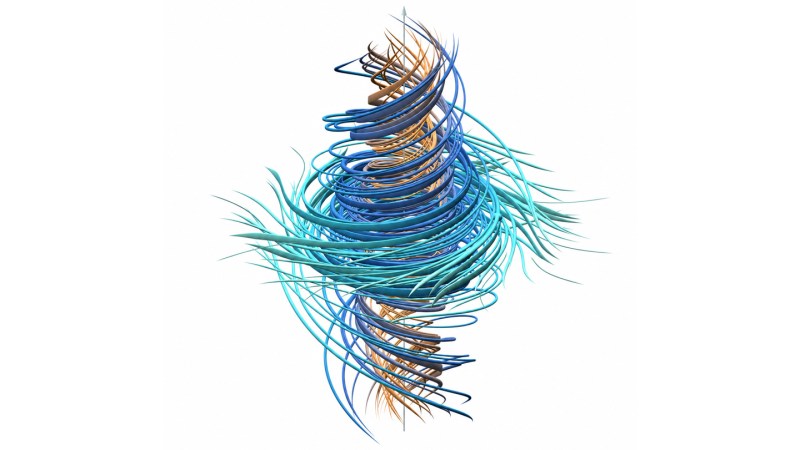
The motion of fluids seems simple, but the equations behind it are the subject of one of the most famous puzzles in mathematics. That puzzle now appears solved, thanks to AI, even as the feat came with a flood of controversy. OpenAI announced September 8 a solution to the Navier–Stokes existence and smoothness problem, which is so monumental that a $1 million prize has been offered for its resolution.
It is a huge deal to know the answer,” says mathematician Dallas Albritton of the University of Wisconsin–Madison, who was not involved with the new work. The day before, a pair of mathematicians had reported an advance on a closely related problem. To do so, Tristan Buckmaster of New York University and Levent Alpöge of the AI company Anthropic relied on assistance from various AI models, including OpenAI’s.
The relationship between the two advances — and whether OpenAI had access to the duo’s progress — has been subject to intense speculation. The Navier-Stokes equations describe the relationships between pressure, density and velocity of a fluid as they change over time. The equations are a foundation of science and engineering, relevant for weather forecasting, studying ocean currents and designing aircraft, pumps, turbines and more.
Despite dating to the 19th century, the equations are not fully understood — in particular, whether they are always well-behaved has not been clear. There might be situations in which the equations break down, producing physically impossible situations like fluid flowing at infinite speed, known as “blowups.” Determining whether the equations are naughty or nice is one of seven challenges selected in 2000 by the Clay Mathematics Institute as the Millenium Prize Problems, each of which has a $1 million bounty. Buckmaster and Alpöge focused on a set of equations called the Euler (pronounced like “oiler”) equations.
While the Navier-Stokes equations include viscosity — a term describing a fluid’s resistance to flow — the Euler equations don’t, making them a stepping stone to the more famous Navier-Stokes problem. The pair found a blowup when an outside force pushes on the fluid, solving what’s called the forced Euler problem.As the pair were finessing their results, rumors began flying about their work. Spurred by these vague rumors, OpenAI researchers started tackling the various Millenium Prize Problems, and quickly focused on Navier-Stokes, using around 10,000 AI agents at a time.
The agents discovered a solution to the forced version of the Navier-Stokes problem: a vortex that gets skinnier and faster until its speed goes to infinity. That means that the Navier-Stokes equations are not always well-behaved, answering the longstanding question. The feat of running so many AI agents cost millions of dollars, OpenAI researchers estimated. (OpenAI stated in a blog post that they will not claim the Millenium Prize.) OpenAI’s solution has been confirmed by Lean, a tool that allows for the verification of complicated mathematical proofs.
Extract — continue reading at the source.
/https://tf-cmsv2-smithsonianmag-media.s3.amazonaws.com/filer_public/58/74/58744720-be88-40a9-a2a1-a4fec11a6f2a/792508615_2953780694972800_6084568669239326733_n.jpeg)
/https://tf-cmsv2-smithsonianmag-media.s3.amazonaws.com/filer_public/98/7e/987e07a0-744a-421e-8eb9-0cccdd8c5cf0/p20260909081500.jpg)


/https://tf-cmsv2-smithsonianmag-media.s3.amazonaws.com/filer_public/59/49/59497682-9b3c-4ff7-9d94-c78d21f661cc/gettyimages-2201698070.jpg)