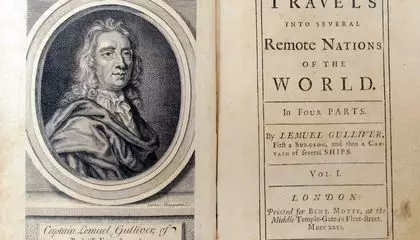
In the spring of 1726, a mysterious cloaked figure visited a London bookseller named Benjamin Motte with a manuscript in hand. Transcribed in unfamiliar handwriting and apparently written by one “Lemuel Gulliver,” the text was called Travels Into Several Remote Nations of the World and told the story of a wayfaring sea captain who visits distant shores—including an island called Lilliput, home to six-inch-tall people—and whose misadventures appeared to poke fun at the elaborate oddities of human nature and British societal norms. Motte enjoyed the tale enough to pay for its rights, even without knowing the real author.
On October 28, 1726, he published the two-volume novel, which was met with instant acclaim. It wasn’t long before the book’s listed author, Gulliver, was revealed to be a pseudonym for Jonathan Swift, a Dublin-born Anglican clergyman and well-known writer and essayist. Now, three centuries after the novel now known as Gulliver’s Travels first appeared on bookseller’s shelves, the literary world is still celebrating the novel as an enduring achievement in political satire and prose.
Translated into dozens of languages while never once leaving print, the novel’s portrayal of class, morality and societal divisions has proved universally time-tested. A post shared by Trinity College Dublin (@trinitycollegedublin) These provocations are front and center in “Gulliver at 300,” an exhibition at Trinity College Dublin, Swift’s alma matter. The show, which is also viewable online, brings together more than 100 versions of the story, from early editions and subsequent spin-offs to the many artworks it inspired.
To this day, the term “Swiftian” is synonymous with bitter satire. But scholars are still debating whether the author himself viewed humanity with such pessimism, or if he augmented these feelings in his fictionalized characters. Some scholars argue that Swift’s unstable identity as member of Ireland’s elite Protestant minority helped shape his biting view of English authority.
Gulliver’s Travels was the origin of several colorful words in English, including “yahoo,” meaning a crass person, and “lilliputian,” after the miniature characters of the first voyage. The exhibition’s organizers are confident that modern-day audiences, especially younger generations, will continue to find the novel and its messages relevant. She adds: “For readers today, fearful of being displaced by AI, Swift’s profound satire of human nature, especially pride in rationality and progress, resonates strongly.” “Gulliver at 300” is on view at Trinity College Dublin’s Old Library and online through December 2026.
Christian Thorsberg is an environmental writer and photographer from Chicago. His work, which often centers on freshwater issues, climate change and subsistence, has appeared in Circle of Blue, Sierra magazine, Discover magazine and Alaska Sporting Journal.
Extract — continue reading at the source.