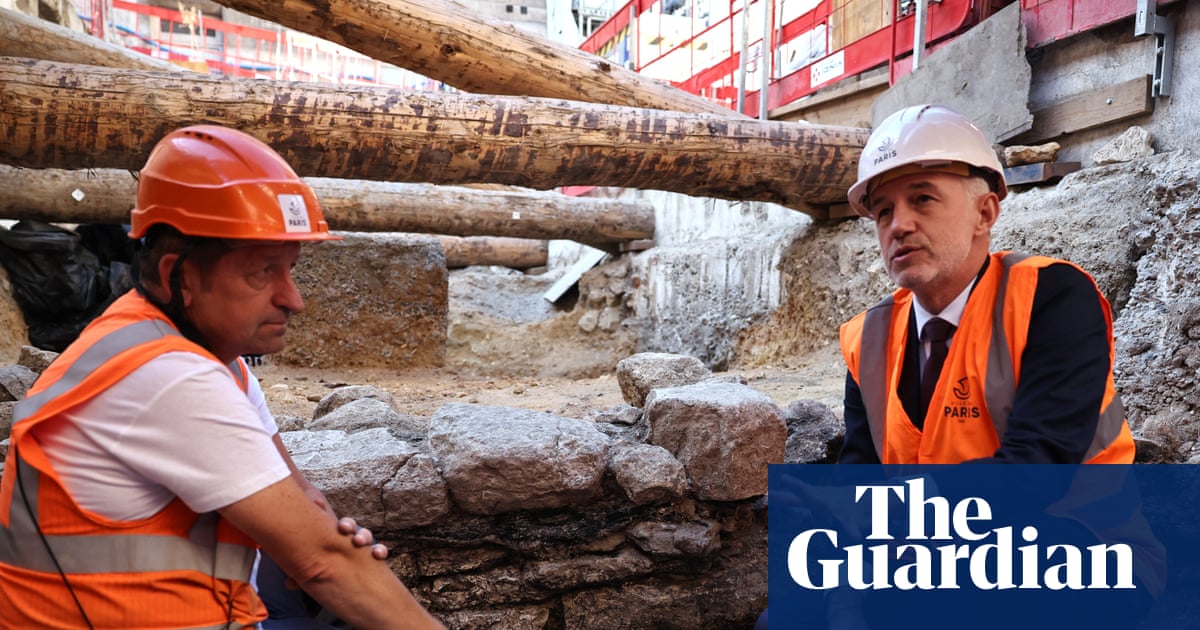
An ancient wall discovered beneath Paris has been described as a “major breakthrough” by France’s culture ministry, with the archaeological find possibly confirming the location of the city’s original settlement. A roughly 20-metre (65ft) stretch of wall dating from the Gallo-Roman period was discovered in Paris this summer beneath a building on the Île de la Cité, near Notre Dame Cathedral in the heart of the French capital. The stone-and-wood structure is thought to be a fragment of the ramparts of Lutetia – the ancient name for Paris – built by the Gallic Parisii tribe who lived along the River Seine in the iron age.
The Île de la Cité has traditionally been regarded as the centre of Lutetia, but a rival theory, backed by some archaeological research, contends that it was in Nanterre, a suburb to the west. The wall, uncovered in the course of excavations beneath the Hôtel-Dieu hospital, bears traces of fire, which may correspond to Caesar’s account that the Gauls set fire to their town before the Battle of Lutetia against the Romans. Carbon dating of the charred evidence dated the find to between 200BC and 10BC, the ministry said in its statement – a timeframe that covers the Battle of Lutetia, in 52BC.
The Île de la Cité is the largest island in the Seine in the Paris region and became the centre of the Roman settlement of Lutetia.
Extract — continue reading at the source.


