This study examined the associations of eating behaviours and physical activity (PA) with depressive symptom severity and the mediating role of self-efficacy among college students in Northwest China. A cross-sectional study is performed from 2022 to 2023 across ten colleges in five provinces in Northwest China. Eating behaviours, physical activity, depressive symptom severity, and self-efficacy are assessed using self-developed eating behaviour items, the Physical Activity Rating Scale-3 (PARS-3), the Patient Health Questionnaire-9 (PHQ-9), and the General Self-Efficacy Scale (GSES), respectively.
Multivariable linear regression and mediation analyses are performed. The final analysis includes 7,041 participants. Using a PHQ-9 cutoff of ≥10, 8.79% screen positive for probable depression.
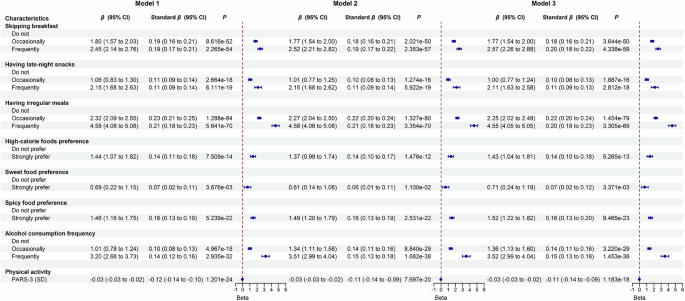
In the fully adjusted model, frequent breakfast skipping (β = 2.57, 95% CI 2.26-2.88), late-night snacking (β = 2.11, 95% CI 1.63-2.58), irregular meals (β = 4.55, 95% CI 4.05-5.05), and strong preferences for high-calorie (β = 1.43, 95% CI 1.04-1.81), sweet (β = 0.71, 95% CI 0.24-1.19), and spicy foods (β = 1.52, 95% CI 1.22-1.82) are associated with higher PHQ-9 scores, as is frequent alcohol consumption (β = 3.52, 95% CI 2.99-4.04). Higher PA is associated with lower PHQ-9 scores (β = −0.03, 95% CI -0.03 to -0.02). For strong sweet food preference, the indirect effect through self-efficacy is 0.29 (95% CI 0.11-0.48), accounting for 40.22% of the total effect.
Specific eating behaviours and PA are associated with depressive symptom severity, and self-efficacy may partly mediate these associations. Symptoms of depression are prevalent among young adults, and college students are more likely to experience poor mental health than their peers1, which may result in anxiety, substance abuse, poor academic performance, suicide, risky and violent behaviour, and put them at greater risk of mental disorders later in life2. According to Franzoi et al., 20.4% of students suffer from moderate to severe depression3.
A cross-sectional study of symptoms of depression among a large sample of first-year students from 12 countries found that 48.1% of students had clinically significant symptoms of depression, ranging from 24% to 86% across different study sites4. In China, over 20% of Chinese college students suffer from depression, and this proportion has been increasing over the past decade5. Diet and physical activity (PA) have been considered as modifiable lifestyle factors for depression6.
Some evidence suggested that eating regular meals can significantly reduce the risk of depression7, and those with the habits of skipping breakfast8 and late-night snacking9 have a 2.92 and 1.44 times higher risk of depression compared to the control group. Unhealthy eating behaviours are prevalent in Chinese university campuses: rates of breakfast skipping exceeding 40% and widespread late-night snacking have been documented10,11. Meanwhile, those with depression tend to prefer sugar-sweetened beverages, fast food, snacks, sweets12, and spicy foods13, and are more likely to have a higher caloric intake12.
Extract — continue reading at the source.