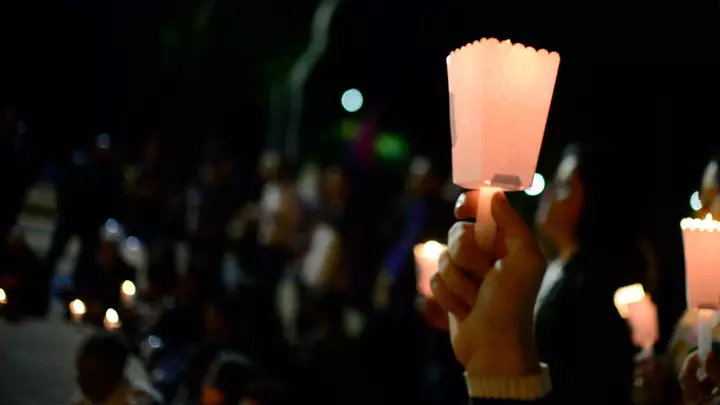
International Day Against Homophobia, Transphobia and Biphobia in São Paulo, Brazil, on 17 May 2017. Photo by Cris Faga/NurPhoto/Getty trained as a nurse and owns a beauty salon in Brasília. He spoke to André Aram in Portuguese.
I was 19 when I first considered becoming a trans woman. I grew up in a household of women: my parents divorced when I was four, so it was just me, my mother and four sisters. Don’t walk like a girl!’ I’d realised from an early age that I was gay.
In elementary school, there was a boy with whom I would hold hands in secret. One day we kissed; a teacher saw and scolded us. That’s when I began to understand this was wrong, though I didn’t know why.
My mother didn’t know how to deal with this. She struggled with mental illness, including body dysmorphia, and rarely left the house; she thought people were laughing at her for being overweight. By the time I was eight, I was doing everything on my own – grocery shopping, going to the bank, taking the bus.
During these errands, I’d sometimes stop at newsstands and admire the male bodies in magazines, fall in love with the princes in the cartoons. Looking back, I realise that, for an effeminate, mixed-race, lower-middle-class boy on the outskirts of Brasília, there was always a predator lurking: a neighbour, a relative, someone with bad intentions. When I was 13, we started attending an evangelical church.
There was no sense of belonging there either, for me; I was always seen as the guilty one. The pastor there would approach me and ask if I was homosexual. We were counting flyers that would be distributed before a religious event.
Extract — continue reading at the source.