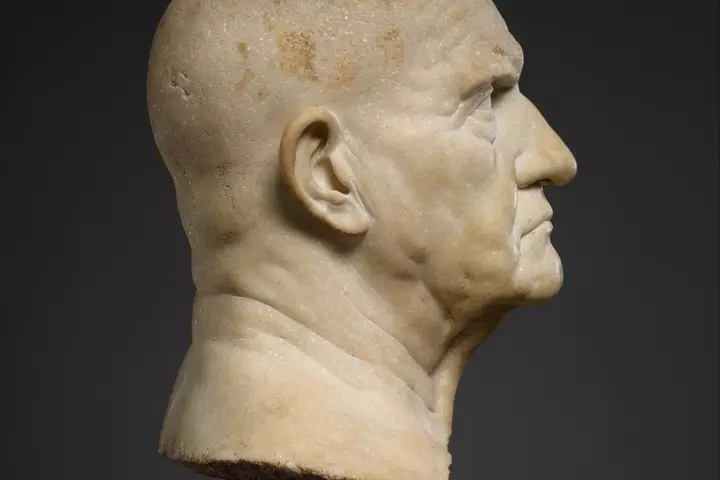
Courtesy the Met Museum, New York What does it mean to be a man? In the early 21st century, masculinity is contested and fraught with anxiety; influencers offer models of manliness involving fast cars, sexual conquests, and building up muscle. Before the rise of feminism, they suggest, in some supposed Golden Age, everyone had a shared sense of what it meant to be a man – and being a man was unproblematically good.
The Roman Empire, in their view, offers men today an inspirational example of power, hierarchy and achievement, which is why men think about it so much – unlike women, who are too immersed in their feelings… Manliness certainly was celebrated in the works of Cicero, republican Rome’s most eloquent statesman. In the mid-1st century BCE, his persuasive powers in the law courts and the senate were second to none; his speeches went on to inspire would-be orators well into the 20th century. He is often seen as the very embodiment of the Roman republic.
The political world in which he flourished was a self-consciously masculine one; to be accused of acting like a woman was, for a Roman man, a grievous insult. Yet in Cicero’s writing we can find other strains too. For Roman men, anything labelled feminine was necessarily to be avoided, something to be ashamed of.
But what exactly did it mean to act like a man? Ancient Rome in the 2nd and 1st centuries BCE saw the rise of a succession of military leaders who were promoted as masculine role models. The great general Marius won a series of victories in Spain, North Africa and on Italy’s northern frontier.
For several years in a row, he was elected consul, one of Rome’s two chief executive officers. Unlike many other Roman politicians, he didn’t have an aristocratic background. One Roman writer imagines Marius fending off accusations that he was coarse in his manners: Here was a model of manliness forged on the battlefield.
Given the military might of ancient Rome, it is surely unsurprising that Romans often associated masculinity with courage in battle. The word virtus, a term cognate with the Roman vir (meaning man as opposed to woman), clearly means ‘courage in war’ when it is first recorded in the mid-5th century BCE. Courage in battle could be taken as the foremost manifestation of Roman masculinity.
Extract — continue reading at the source.