By the middle of the 20th century, it had begun to seem that biology was almost solved. Charles Darwin’s theory of evolution by natural selection explained how organisms change and adapt. The modern science of genetics showed how it works at the molecular scale.
Genes governing the traits of organisms get passed down from parent to offspring, and random mutations create the variations from which natural selection picks the “fittest.” Natural selection and genetics fitted together in what the biologist Julian Huxley christened “the modern synthesis” in his 1942 book. Once it was shown in 1953 that the genes are encoded by DNA, the rest of biology looked like little more than piecing together details. But not everyone was satisfied.
The British biologist Conrad Hal Waddington, known to his friends and colleagues as Wad, thought this focus on genes was all very well. But it wasn’t clear to him, or anyone else, exactly how genes shape the forms and features of organisms — how they reliably generate all the different tissues of the body, in all the right places, during embryonic development. Around the same time that Huxley unveiled the modern synthesis, Waddington presented a novel picture of how this might unfold.
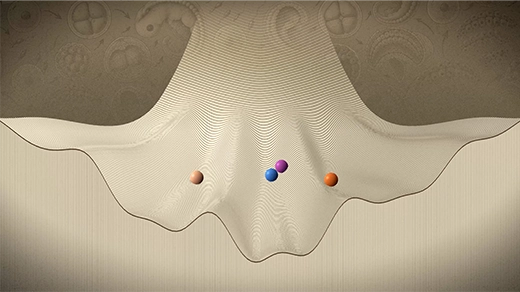
He visualized the developmental process as a landscape with hills and valleys that split every so often like those in a river network. At the very top of the highest hill he imagined a ball, which represented a population of cells in their earliest embryonic form — what we now call stem or pluripotent cells, which have the potential to become any cell type. The progression of the cells towards their fates — to become, say, skin cells, muscle cells, or nerve cells — is like the ball rolling downhill through the landscape.
When the ball reaches a branching point (bifurcation), the model’s “gravity” pulls it to one track or the other: In scientific terms, it must differentiate. Through a particular sequence of such branching decisions, Waddington argued, cells specialize into their mature types, or fates, each expressing a particular set of genes. The cells are restricted to a small number of well-defined states because they are “canalized,” in Waddington’s lexicon: trapped and channeled by the sides of the valley.
In this way, a limited number of cell types reliably arise from the activity of an army of genes. Waddington’s landscape has been “remarkably useful as a conceptual scaffold,” said James Briscoe, a developmental biologist at the Francis Crick Institute in London. But the concept was more of a visual metaphor than a representation of an actual biological process.
Extract — continue reading at the source.
/https://tf-cmsv2-smithsonianmag-media.s3.amazonaws.com/filer_public/5a/2d/5a2d2d01-d4ad-4e91-b743-52bae6648a07/boat_crossing_bubble_barrier_-_credits_the_great_bubble_barrier.jpg)
/https://tf-cmsv2-smithsonianmag-media.s3.amazonaws.com/filer_public/a7/7b/a77be531-cb07-4a9e-a6dc-155b6c26f63d/saint-helena-plantation-house-jonathan-the-tortoise-by-kevin-gepford-02.jpg)