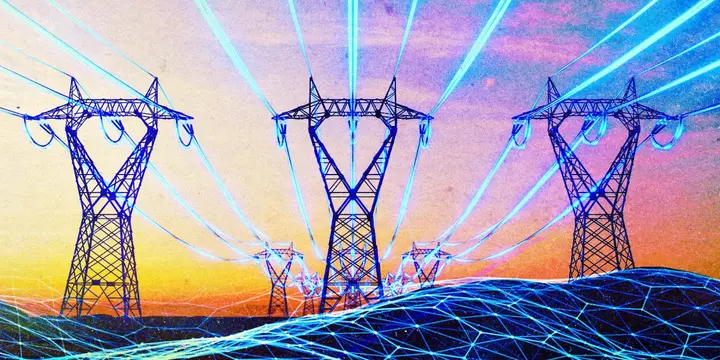
Transformers are a crucial but nearly invisible part of our grid. The devices help efficiently move power across long distances, but they’re complicated and in short supply. And given that their basic design hasn’t changed much for about a century, they could use an upgrade.
As the world races to meet rising electricity demand from EVs, data centers, and more, researchers and companies are looking to modernize transformers. New, solid-state versions could help relieve some of the supply concerns and make sure the grid can handle the growing pressure. Conventional transformers generally rely on huge amounts of specialized steel alloys and miles of copper wire to do their work of transferring electricity between circuits.
Solid-state models, in comparison, combine magnetic components with high-power semiconductors, making them more compact and allowing for more control over the flow of electricity. These devices are still in development, and can’t replace all traditional transformers today, especially the largest ones that work at the high voltages necessary for long-distance transmission. But a new generation of transformer technology could be a crucial part of our future grid.
Moving electricity through the grid isn’t perfectly efficient: As electricity flows through power lines, some gets lost as heat. How much varies—the higher the voltage, the lower the current, and the less electricity gets lost. So a key function for the grid is stepping voltage up and down.
Consider, for example, your local solar plant. For that electricity to efficiently travel to your home hundreds of miles away, it needs to reach a higher voltage than what’s generated by the solar plant. In its path from the power plant to your outlets, electricity might go through one transformer at the solar farm and another at a substation nearby, stepping up the voltage twice to reach a high enough level to travel on high-voltage transmission lines.
Solar panels also produce direct current (DC) electricity, which needs to be converted to alternating current (AC) via an inverter before it flows into a transformer. Closer to its destination, the voltage will be stepped down again, probably at least twice: once at another substation and again at a smaller transformer in your neighborhood. If you’re in the US, electricity from a solar plant might be converted to AC by an inverter at around 480 volts, get stepped up to 115,000 volts for the transmission lines, and finally get stepped back down to 120 volts and 240 volts for your home.
Extract — continue reading at the source.